
English source · 95 min
Veyndo: current status
For the whole-shop architecture, public repositories and independent entry points, see One shop, composable parts. The local Checkout comparison records equivalent quote results and catalog availability across a Checkout restart. Hosted capacity remains a separate test. Measurement.
Updated 12 November 2026. Start here for the public product, observed journeys and remaining delivery work. Source code, passing tests and a successful public journey are tracked separately. The 4 November PayPal journeys use the actual provider Sandbox; earlier purchases retain their stated simulation scope.
Hosted component API
The API-only origin gives SDK clients the existing Store, merchant, MCP and
UCP entry points. Core build humble-steel-3125 passed snapshot, migration and
Northflank readiness checks. Public checks read the Lumen catalog, payment
options, MCP tools and UCP profile on the API origin. Requests without shop
scope, merchant authorization or for native pages were rejected as expected.
Studio and the public Lumen storefront responded on their existing origins.
API profile and examples.
Platform at a glance
- One shop. Core owns prices, inventory and orders. The hosted Lumen pilot runs eight pinned services. The native shop and original Storyfront share the order and inventory ledger. Component map · Hosted composition.
- Checkout. Native and embedded Storyfront purchases completed through the separate Checkout service with PayPal Sandbox. Both returned to empty carts and were refunded. The separate simulated paid-order Flow generated an invoice. The paid order through invoice and external mailbox is the next hosted acceptance step. Lumen evidence · Acceptance order.
- Apps and agents. Installed MCP Apps can surface interactive views for shoppers and merchants. Studio can open an admitted working view for products, orders or customers. SDK 0.4.15 gives external hosts the same A2UI adapter. Agentic UI guide.
- Developer entry points. The Core, SDK, Apps and Marketplaces repositories are public. The component map describes the separately hosted pilots, the published interfaces and how to start with one component. Repositories and examples.
- Operational evidence. The exact hosted versions and migration boundary passed the composition check. The recorded performance comparison covers an isolated workload. Hosted capacity and automatic composition admission before promotion remain open. Measured workloads · Component tasks.
Product and category layouts in Studio
Shop design opens channel layouts for product pages and categories. Move native commerce sections, add content and set the appearance. Product and category records open through their own actions. Marketplaces brings seller accounts, offers and incoming orders together. B2B follows the active shop settings and current permissions.
The isolated browser test opened a private workspace from the live view, scrolled both Canvas views, reordered sections and published the two selected layouts. The native storefront rendered the saved order and the category grid used the selected four columns. A customer added an item to the native cart from the rearranged purchase section. Changing the shop's B2B setting removed company, quote and EDI navigation. Visual workspace · Studio navigation.
Resume paused shop creation
Studio and the hosted setup wizard create shops without a per-account shop count limit. Jobs paused under the former limit can resume from the saved draft. Studio and hosted setup.
A2UI working views in Studio
The Studio A2UI rollout used Core build vital-arch-6042 from
ad1f8bb5.
The release completed the PostgreSQL snapshot, migration job and Core
readiness checks. All eight active services matched the composition lock.
The public Studio served the exact workspace JavaScript tested locally.
The public Lumen catalog and product detail responded after the rollout.
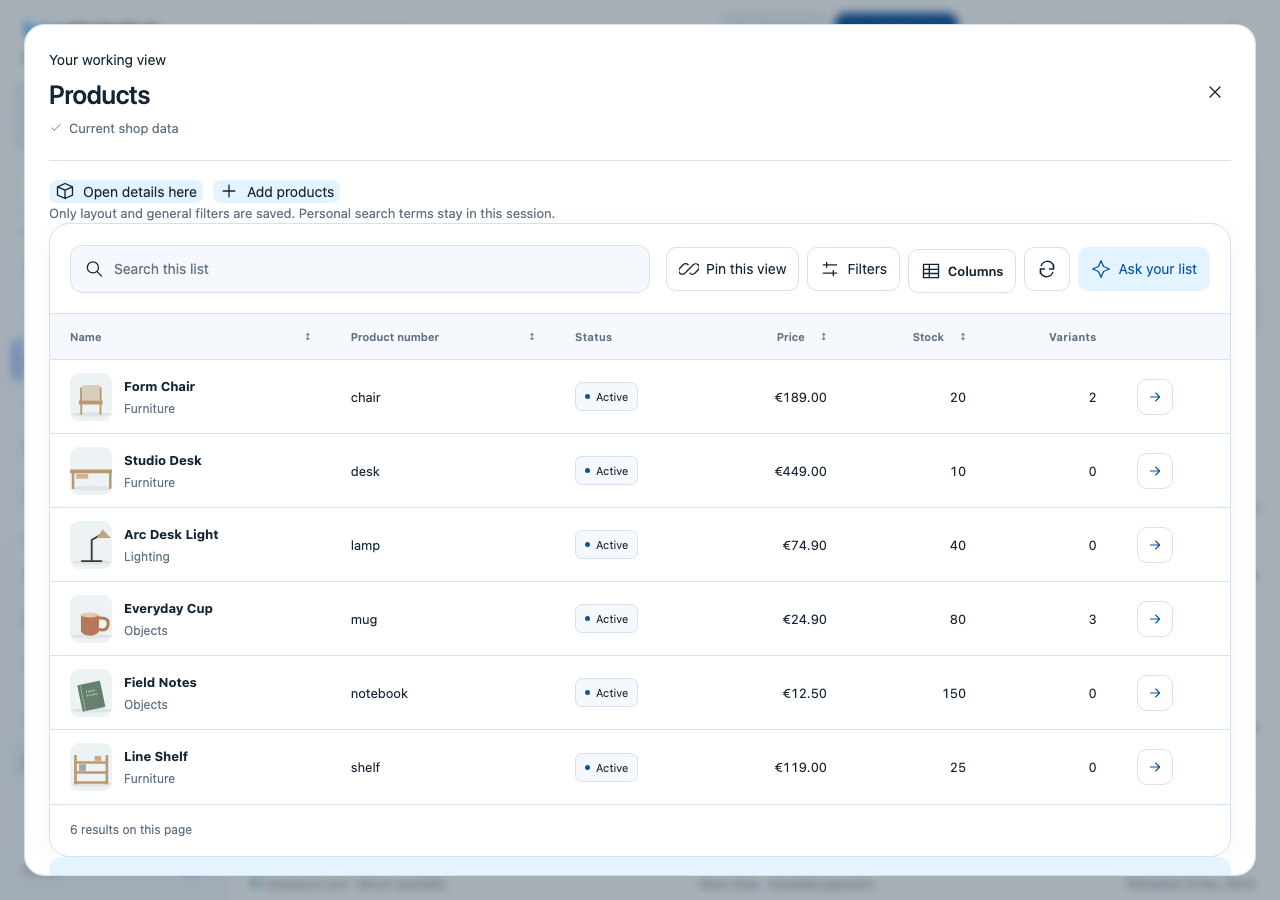
Studio projects its product, order and customer working views through the SDK 0.4.15 A2UI adapter. The current domain rights still govern the native directory, details, intake and shipping controls. In Chromium, a saved assistant proposal from the local Core opened a real product directory with the permitted CSV intake panel. An unsaved product name survived closing the intake panel and the native editor saved the change. A separate API read confirmed the saved value. The working view fit the mobile viewport. The browser run used an isolated PostgreSQL database and a controlled model response. Targeted checks covered losing intake or directory access and falling back to OpenUI.
Studio guide · Browser screenshot.
Shared A2UI adapter for external workspaces
SDK 0.4.15 lets external hosts render admitted workspace views with A2UI v1.0. Connected Shop uses the shared adapter and the official Lit renderer. Browser and SDK checks.
Shared Core and App Worker schema check
The required GitHub verification checks the shared migration history from
both pinned commits. The Lumen lock passed with Core at migration 113 and
the App Worker at migration 112. A fresh Git repository fetched the exact
commits and passed the same check. Tests reject a rewritten migration,
a worker ahead of Core and a boundary that omits later files in the build.
Northflank built and deployed Core 6542950b. After the snapshot
and migration run, all eight live deployments matched the updated lock.
The public Core health and Lumen product reads passed.
Shared schema check.
Buyer password changes in the SDK
SDK 0.4.14 changes the signed-in buyer's password through the existing HttpOnly session. In local Chromium, Core rejected the wrong current password and kept the active session. A successful change replaced that session and revoked a second browser session. The buyer completed the simulated purchase through independent Checkout and downloaded the purchased file. A new sign-in accepted the new password and showed the original order. Password change walkthrough.
Buyer registration and sign-in in the SDK
SDK 0.4.13 uses the shop's HttpOnly session for registration, sign-in and sign-out. In local Chromium, sign-in retained the guest basket and replaced its token. Core rejected an invalid password and the old cart token. The buyer completed a simulated purchase through independent Checkout, saw the order and downloaded the purchased file. After sign-out, Core denied both the profile read and use of the signed-in open cart token. Buyer session walkthrough.
Account and Checkout SDK in the shop browser
SDK 0.4.12 reuses the shop's HttpOnly buyer session. Chromium exercised registration, profile and address writes, a simulated purchase through the separate Checkout service, order recovery and a purchased download. After logout, Core denied the next profile read. The local test used the installed release package. Browser session walkthrough.
Purchased downloads in the SDK
SDK 0.4.11 lists purchased digital files and downloads their bytes. In a local test with separate Core and Checkout services, a buyer purchased a digital item alongside a physical item. The buyer saw the German title and downloaded the original bytes, including after the merchant withdrew the file from sale. Core denied the file to a different buyer and an anonymous caller. Public Lumen required a buyer session for the file list. Download walkthrough.
Buyer profile in the SDK
SDK 0.4.10 reads the signed-in buyer profile and saves editable contact fields. In a local purchase with separate Core and Checkout processes, editing the contact preserved identity and saved addresses. Core rejected an unavailable payment preference. The buyer completed the purchase and read the order and PDF invoice. A second account kept its own profile and empty order history. Public Lumen required a buyer session for profile reads. Profile walkthrough.
Buyer address book in the SDK
SDK 0.4.9 reads, creates, updates and deletes saved addresses. In the local composition, a buyer used a saved shipping address in a simulated purchase through independent Checkout. Core rejected a different buyer's write and stale revisions. Editing and removing the saved address after purchase preserved the original shipping address and downloadable invoice. Public Lumen required a buyer session for address book reads. Address book walkthrough.
Typed buyer order history
SDK 0.4.8 downloads a buyer-visible receipt as PDF bytes. A local simulated purchase through the separate Checkout service produced an invoice. The buyer downloaded it with the installed SDK. Core rejected the same download for a different buyer. Public Lumen requires a buyer session for receipt downloads. Account walkthrough.
SDK 0.4.7 reads buyer order history and detail with receipt metadata. The installed package read a simulated purchase from independent Checkout and matched its amount and invoice in the account. With 100 additional synthetic orders in local PostgreSQL, it read a page of 100 and a second page of one, with no repeated orders. Core denied the detail and cursor to a different buyer. The public Lumen shop required authentication for order history. Account walkthrough.
Connected Shop with the typed SDK
The public Connected Shop source pins SDK 0.4.6. Its Node host uses the catalog client for variants and the Checkout client for cart preview, reviewed apply, confirmation and receipt lookup. In the local Chromium test, desktop confirmed normally and mobile recovered the receipt after the Core response was dropped. Both selected the same Graphite variant, reloaded the original receipt and showed an empty cart. With separate Core and Checkout databases, Core recorded two orders and deducted two units. The guide filter stayed on the product family. Run Connected Shop.
Typed Checkout SDK
SDK 0.4.6 reads the available checkout choices and saves the buyer's selection at the current cart revision. The installed package read the public Lumen options. In an isolated Core and Checkout test, it selected standard delivery, switched the payment method, rejected an unavailable method and a stale revision, then confirmed the simulated purchase with the updated amount. Shipping and payment walkthrough.
SDK 0.4.5 adds typed cart reads, additions and reviewed replacement. The installed package previewed a change without saving it. Core rejected a stale revision and a changed proposal, then applied the reviewed basket. The accepted total carried into a simulated order through independent Checkout. Cart walkthrough.
SDK 0.4.4 adds draft creation, purchase confirmation and original receipt lookup through the Core relay. In an isolated test with separate Core and Checkout processes, the installed SDK completed a simulated purchase and recovered another after the confirmation response was lost. The corrected Connected Shop example displayed its normal confirmation directly. The three purchases produced three orders and deducted three units of stock. Public Lumen rejected the same SDK's anonymous draft request. Checkout walkthrough.
Typed catalog SDK
SDK 0.4.3 includes a runnable browser example and a command line example. The browser host uses the published catalog client against Lumen. Chromium at desktop and mobile widths loaded two distinct product pages, opened a product with the keyboard, showed the returned price and stock, and handled an empty search. Run the browser example.
SDK 0.4.2 exposes public catalog listings, localized product details and variant pages to JavaScript and TypeScript. The installed package read two distinct public Lumen catalog pages, opened the German product detail and returned the expected error for an oversized page. Against a local Core and PostgreSQL, it read a complete family one page at a time and retained the selected SKU across pages. Both tests used the Store API. Run the example.
Hosted component readiness
The composition verifier checked all eight locked Lumen services on 11 November. Each reported its configured running instance. The seven services with readiness probes reported success, as did the configured liveness probes. The App Worker reported a running instance. Worker execution is checked in the separate purchase recovery rehearsal. Release procedure.
Core build elevated-credit-8533 from 202c182c passed the same composition
check before and after the Northflank rollout. The seven peer artifacts and
the pinned schema inputs matched. Core health and the public Lumen Storyfront
returned HTTP 200 after deployment.
Two local purchase rehearsals passed with separate Checkout, Core, Worker and Connector processes. One recovered the original receipt after response loss and a restart. The other traced a simulated provider capture to one invoice, one SMTP test receipt and the original refund on replay. Lumen Studio still shows external delivery disabled in test mode, with no configured sender or SMTP host. A fresh provider payment with delivery to the test mailbox remains open. Purchase recovery procedure.
Website and handbook refresh
On 12 November the public homepage linked directly to this status overview in
English, German, French and Spanish. Experience build curious-scarf-8443
(5f1c2c26) changes the homepage and repository guide. The published
component inventory records the exact Experience image alongside its peers.
Open the homepage handbook section.
The public website at veyndo.ai now opens with three entry points for a native shop, Storyfront and the JavaScript SDK. The new Product Guide and checkout screenshots come from the 11 November tests. The public handbook labels the German architecture overview and the English technical guides in chapter navigation and search. Older evidence retains its original dates. Documentation guide.
That rollout deployed Experience 944943ea (build tranquil-sleep-9688) and Core
61f4a6c9 (build unwavering-face-5739) for this refresh. The release
inventory matched all eight live artifacts after rollout. Both schema inputs
were unchanged. Experience readiness returned HTTP 200 in
storyfront-native mode. This was a website and documentation acceptance.
Historical links and film downloads
Five former GitHub Pages prefixes now open the organization handbook in a browser, preserving the article, language query and section. The four SRT caption files are available on both public handbook hosts. The live check matched 154 media responses and played the four current films in the browser. Compatibility notes.
The standard Core release workflow also published build choice-match-7220
from documentation commit 34fac17e. All eight running artifacts matched
the release inventory after deployment. The public shop, catalogue, native
shop setup and Experience readiness returned HTTP 200.
Shared customer input contracts
The shared customer input extraction is locally validated: Contact and Address now come from the transport-free Commerce crate, including their original syntax checks and defaults. All 23 Commerce crate tests and seven targeted HTTP/PostgreSQL suites pass. These exercise accounts, manual orders, CRM history, tenant isolation, checkout handoff/review and international eligibility. The standalone Rust example runs without Core. Account identity, PII and immutable order ownership remain with the existing native host. Contract and example.
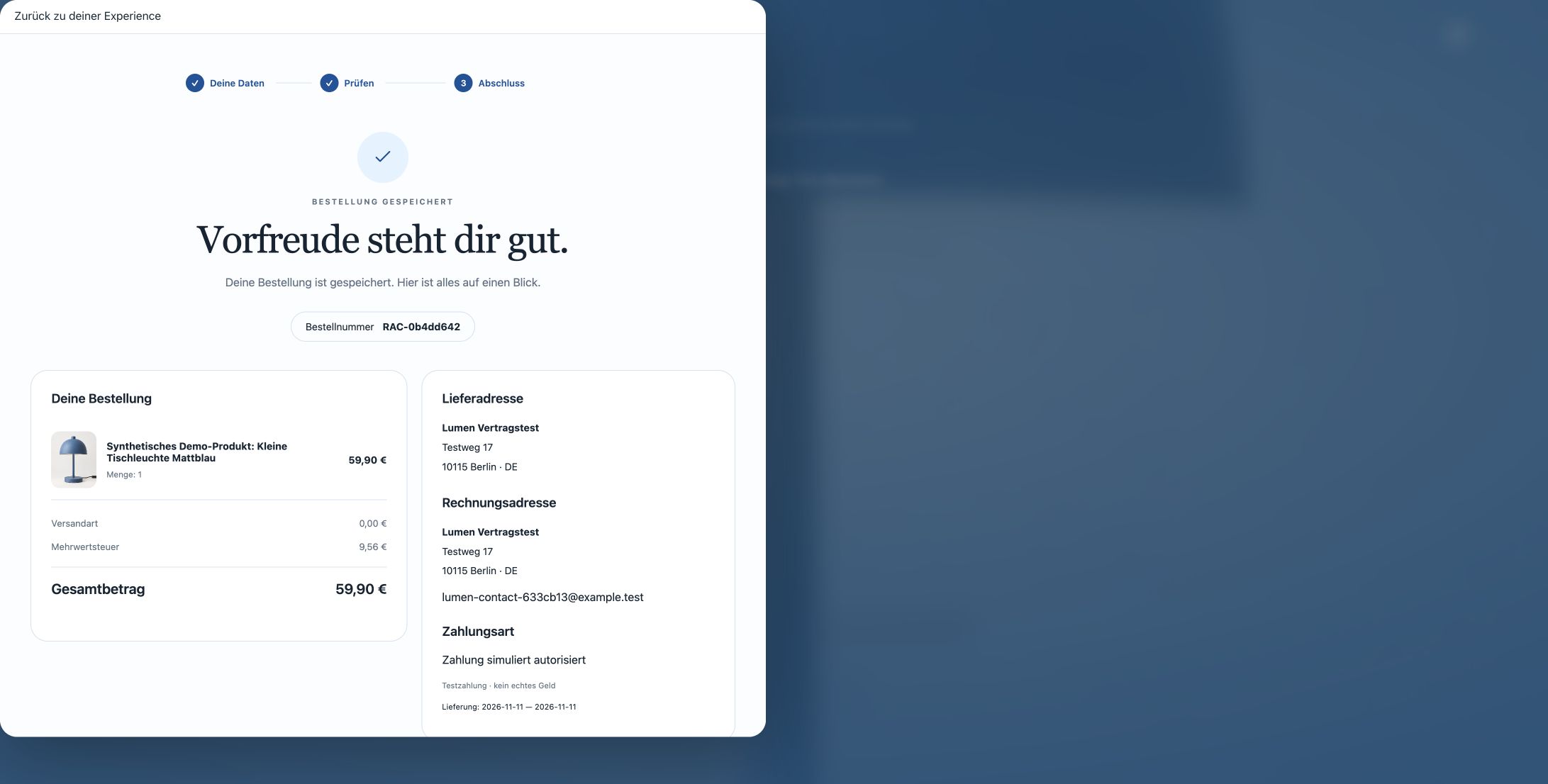
Core 633cb13a (Northflank build chunky-table-1730) passed the exact
eight-service comparison before and after deployment. In the original public
Lumen Storyfront, one synthetic lamp was restocked and purchased through the
embedded checkout with a simulated payment. Order RAC-0b4dd642 confirmed
€59.90 including €9.56 tax. Native Studio showed the same synthetic contact and
the billing and shipping addresses submitted in the frame. After returning to
Storyfront and reloading, the bag was empty and the lamp was sold out.
This purchase did not use PayPal or send a test email.
Checkout confirmation and empty bag after reload.
Shared order and inventory inputs
Marketplace paid snapshots use the shared Commerce validator for exact amounts, tax and address shape. Native checkout, POS and Marketplace pass the same checked quantity representation to the allocation ledger and stock write. Core still books the order, stock and event in one transaction. The storage adapter no longer needs the original cart. There is no added network call.
The three PostgreSQL suites covered the last unit across channels, exact stock
after repeated cancellation across replicas, concurrent content edits, and
tenant isolation. The independent Checkout build eaa34f27 also recovered the
original order and payment attempt after losing the confirm response. Local
PayPal fixtures covered approval, capture and refund; no external provider was
called. Inventory boundary ·
Marketplace intake.
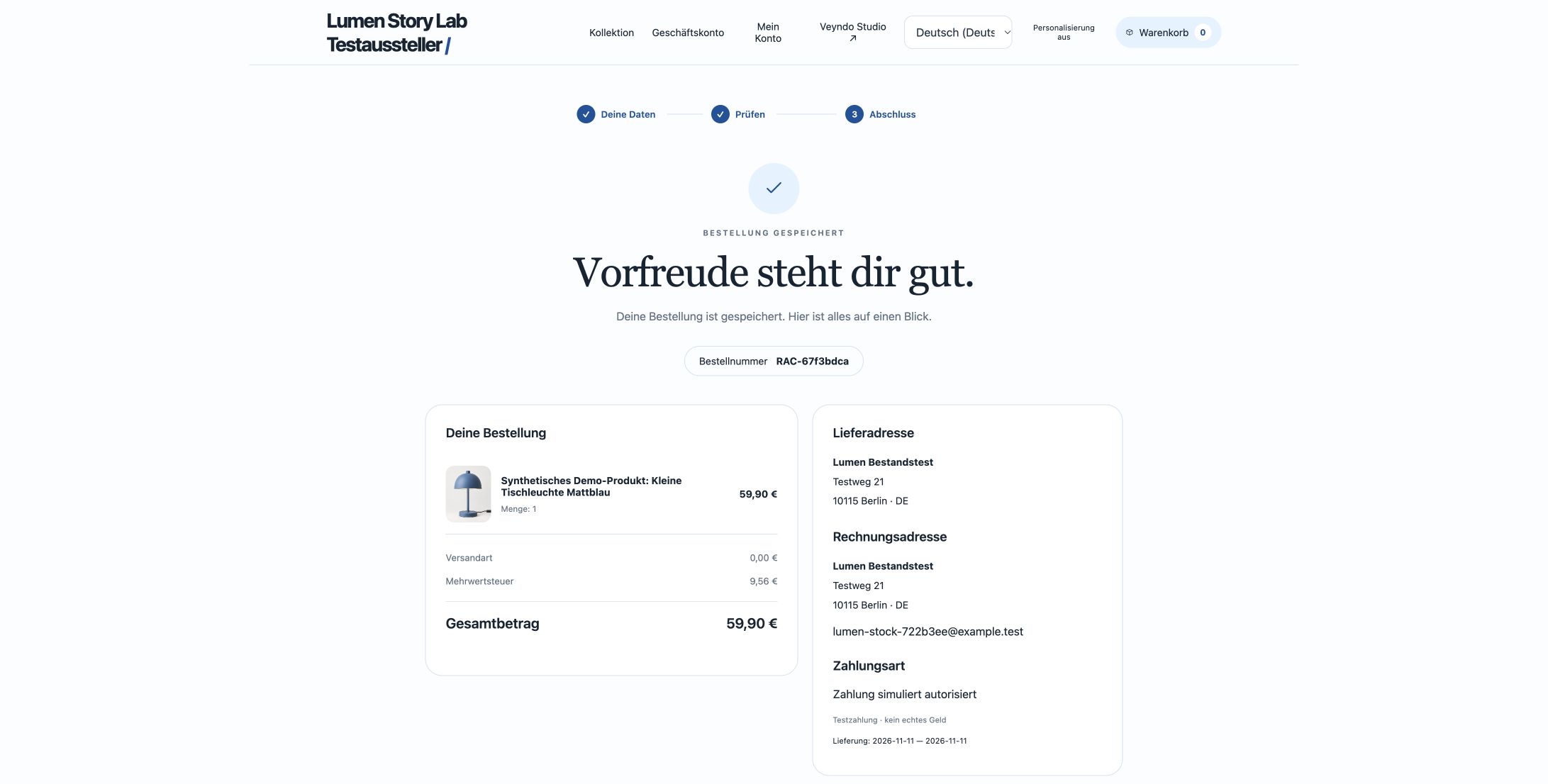
Before promoting Core 722b3ee6 (build airy-umbrella-6504), the release
check matched the previous eight running artifacts and prepared the candidate.
After rollout, all eight running services matched that candidate. A product
from the public App-guided cart
completed the native simulated checkout as order RAC-67f3bdca (€59.90).
Studio showed the order; after returning and reloading, the native cart
was empty and the original Storyfront reported the shared lamp sold out.
Native confirmation.
Product Guide actions in the hosted shop
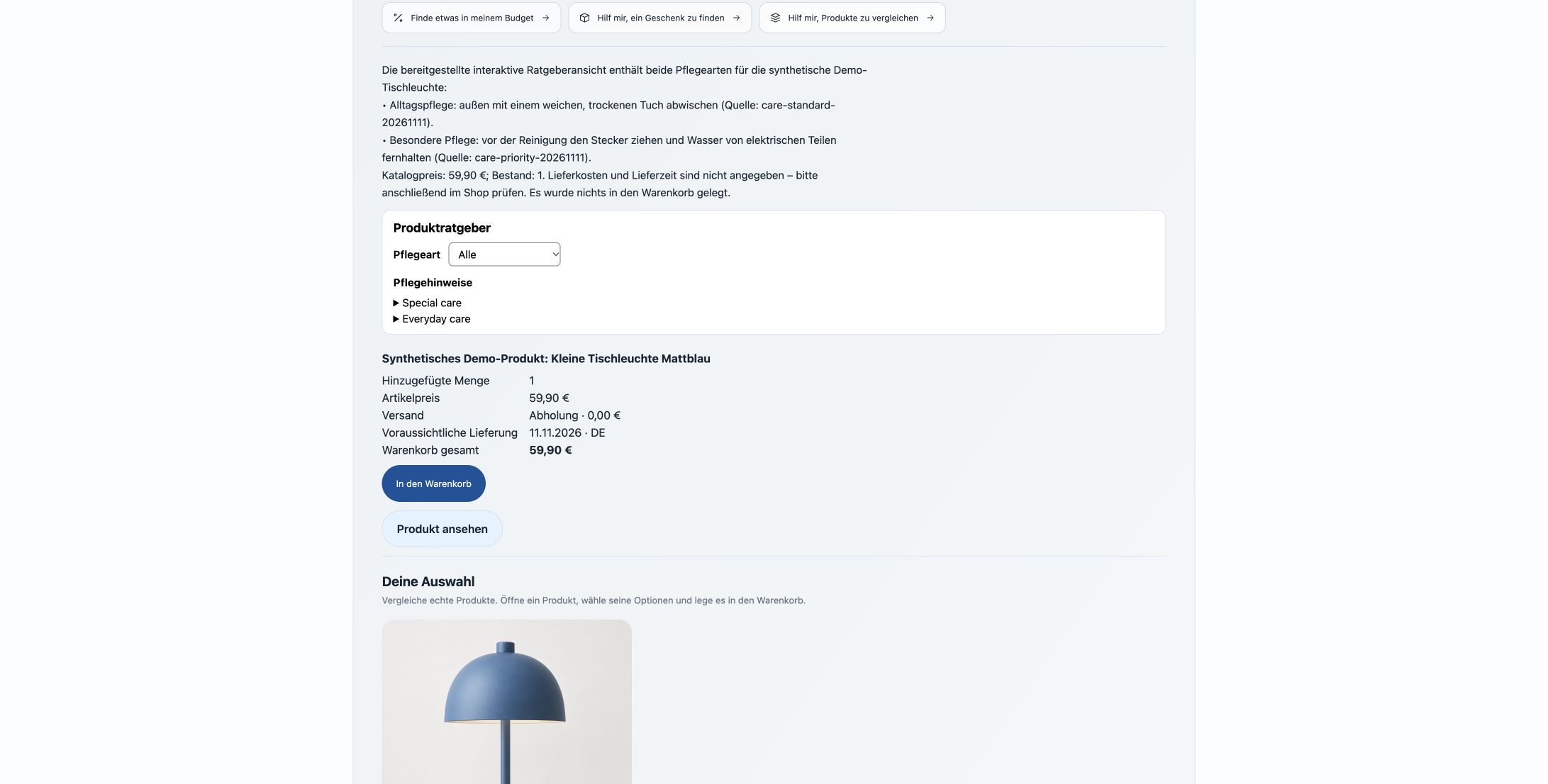
The public native storefront opened the Product Guide with the actual model and a synthetic lamp in stock. The host calculated €59.90, the delivery estimate and collection at €0.00. The cart stayed empty during the review. Selecting Add to cart added exactly one unit. The same action on a sold-out product offered no cart confirmation. The lamp has no distinct variants.
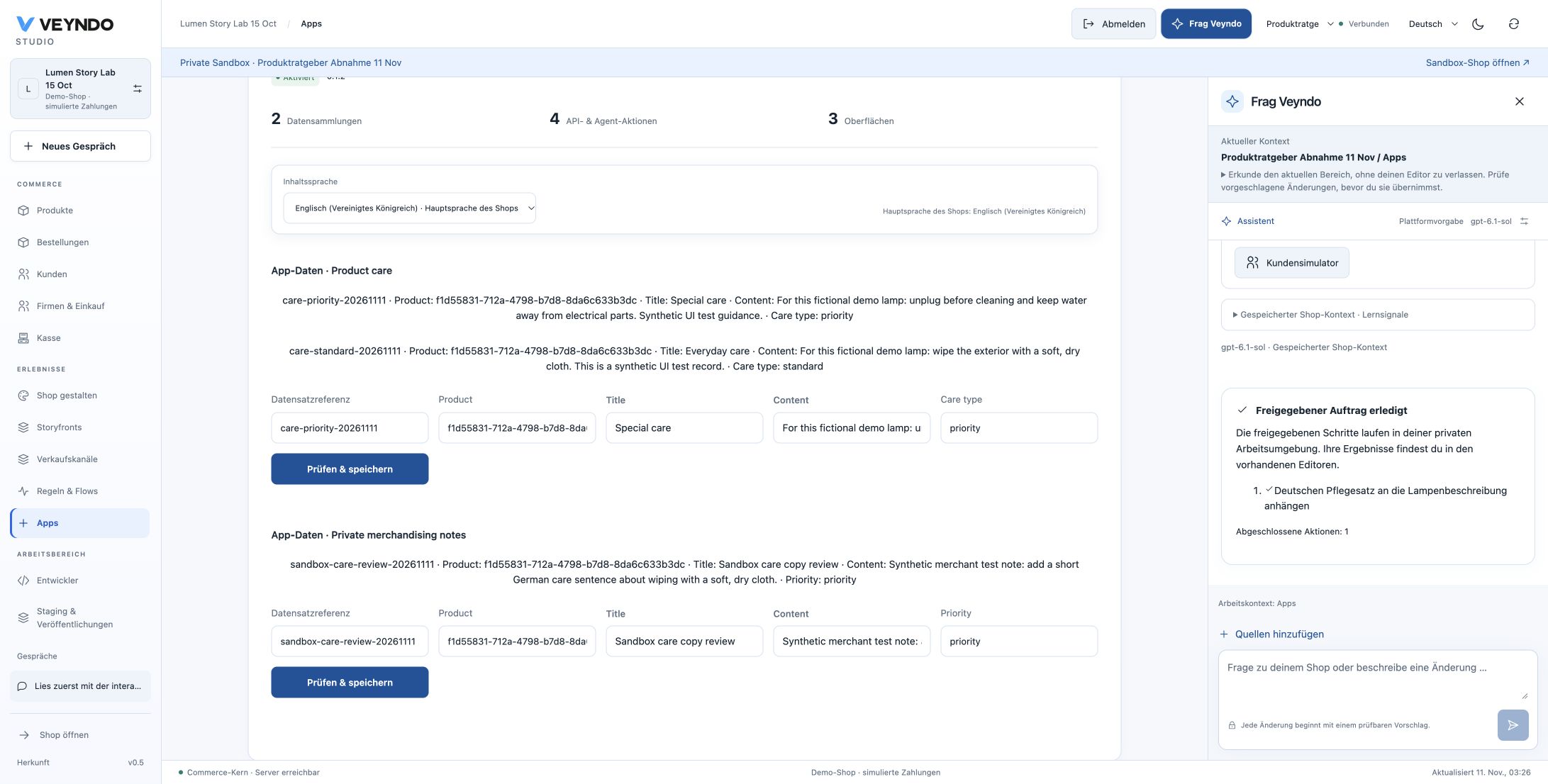
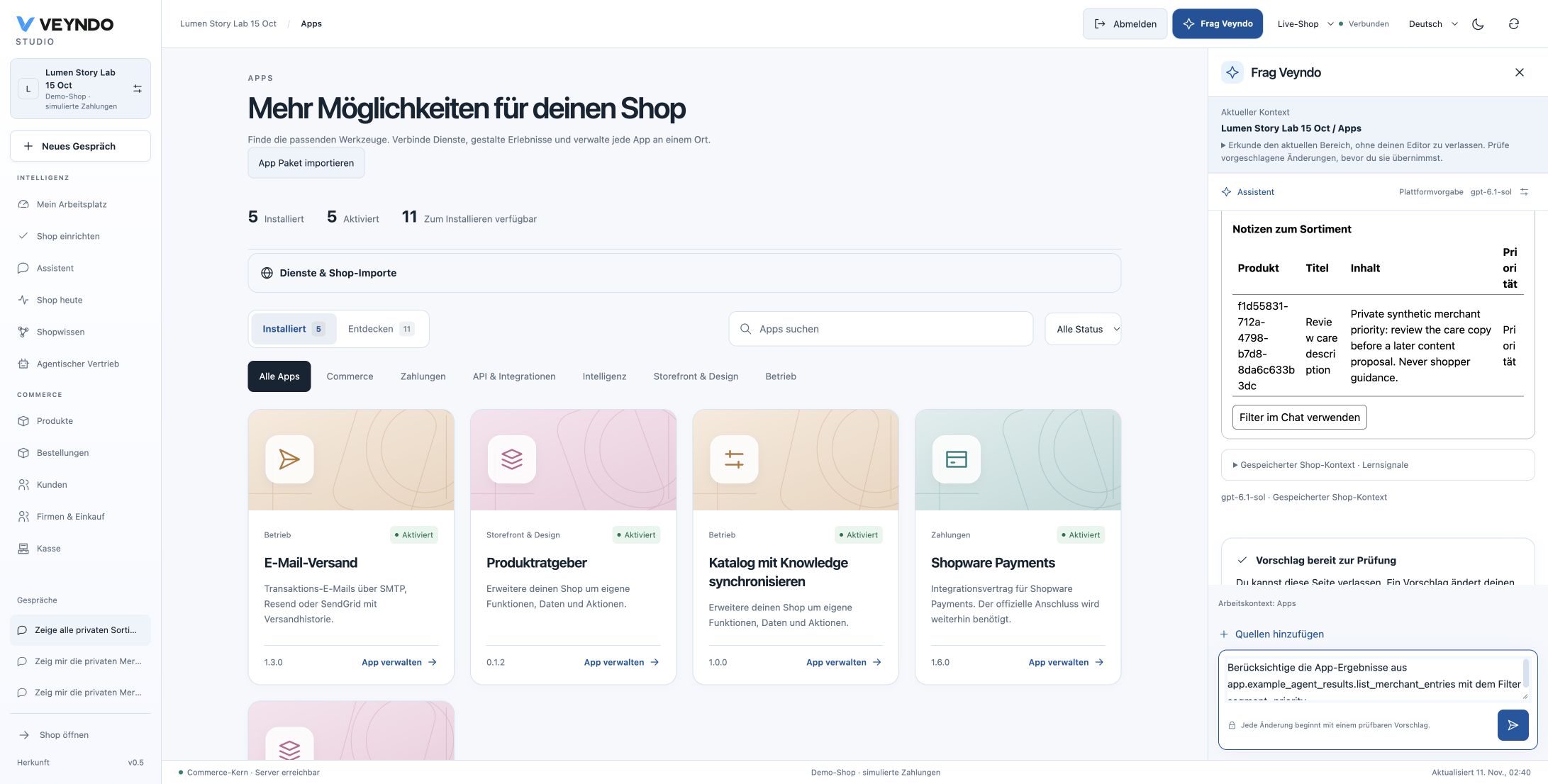
Studio refused to prepare an executable product change in the live workspace. In the private Product Guide acceptance sandbox, its public care records were available while the private notes started empty. A new synthetic private note then informed the actual model's proposed German care sentence. Studio showed the App table and the stored proposal in the same answer. After explicit approval, one action completed and the sentence appeared in the sandbox product editor. The live product description did not change.
Cart review · Approved sandbox change · Reproduce both actions.
Product Guide variant selection
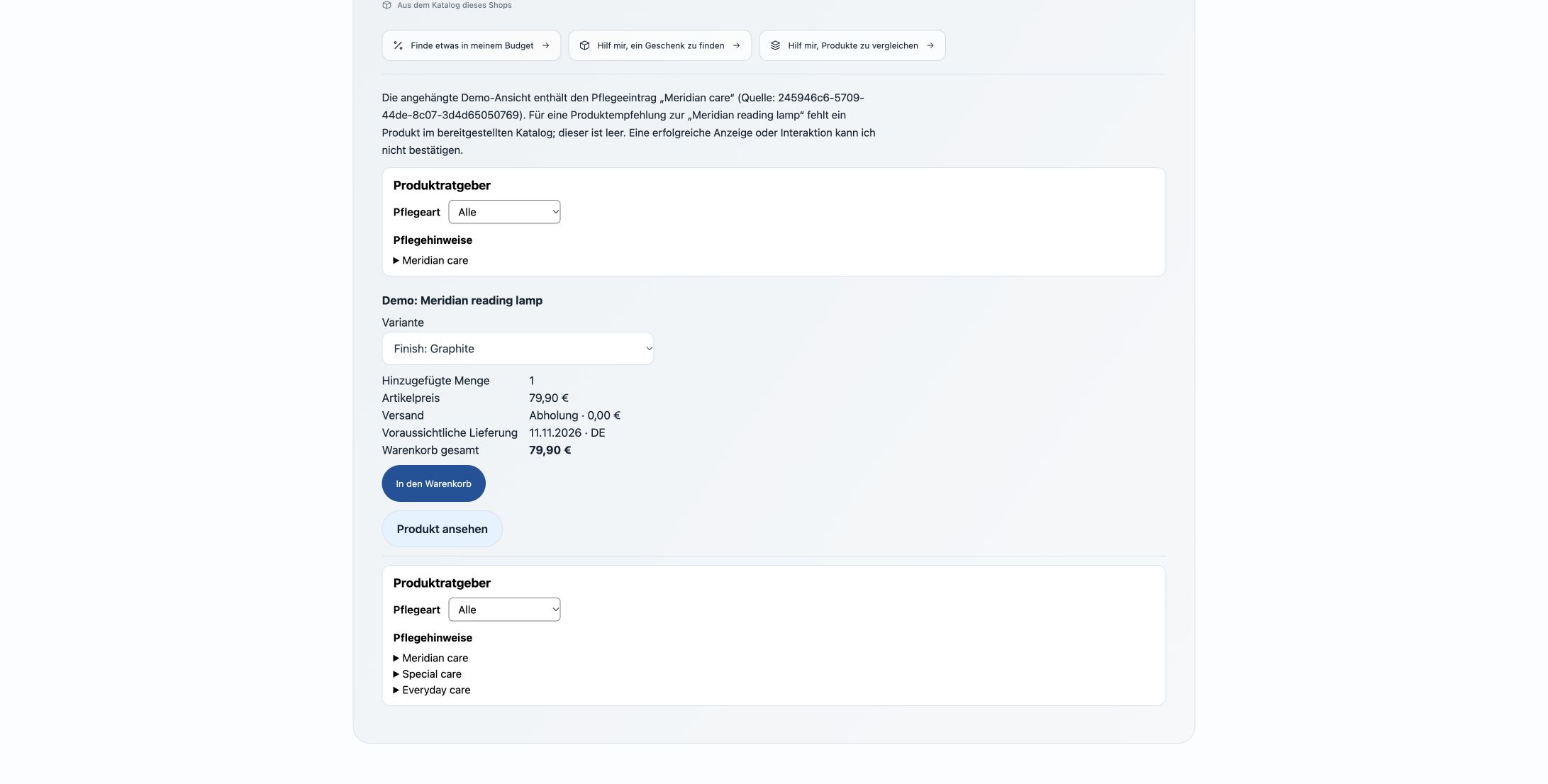
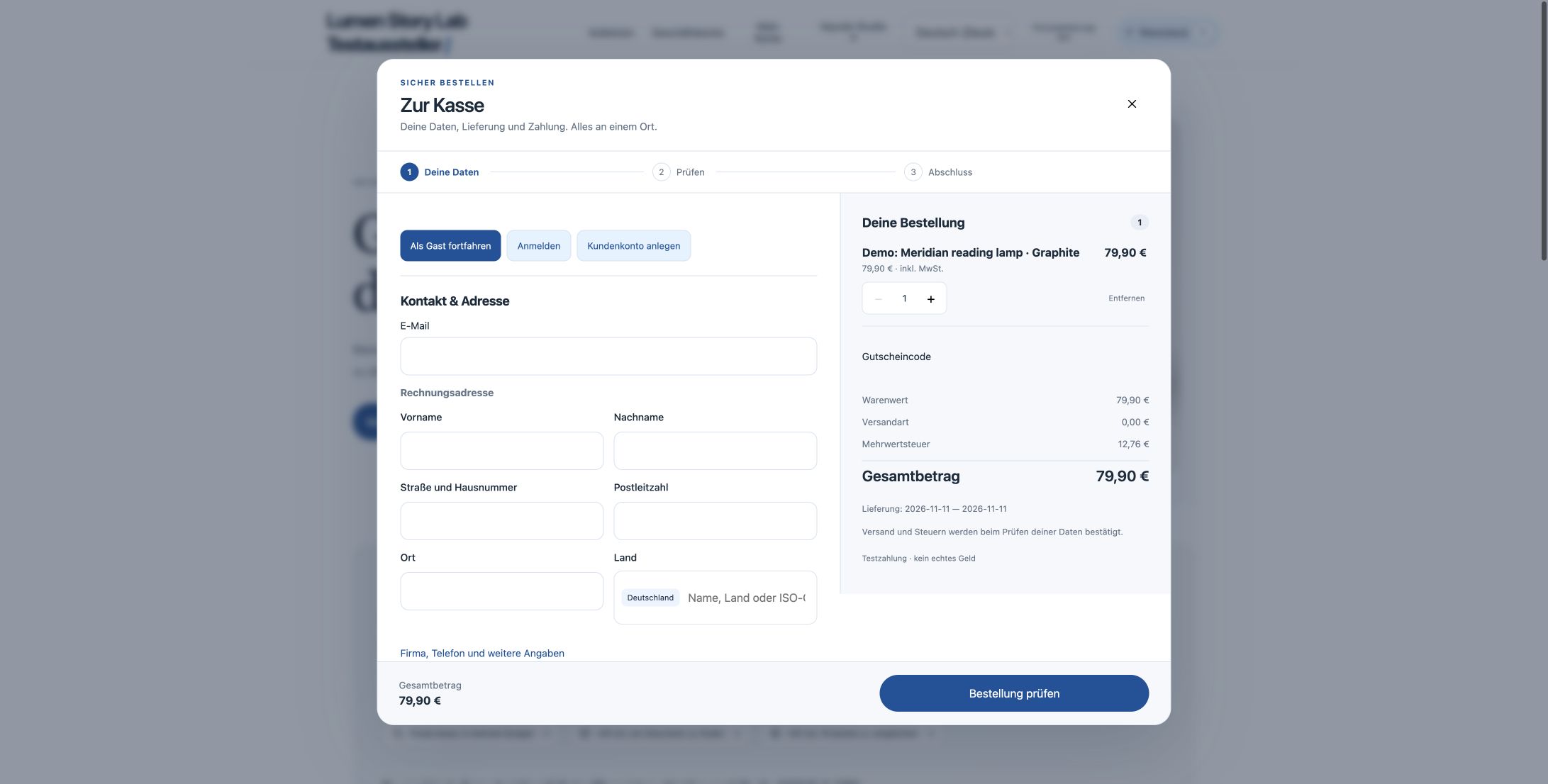
On 11 November, the public native Lumen shop opened the Product Guide 0.1.2 for a synthetic Meridian lamp. With Brass out of stock, the picker offered Graphite. With both available, the host quoted €64.90 for Brass. Changing to Graphite cleared that offer and required another review. Core then quoted €79.90 and collection at €0.00 in Germany. The cart stayed empty through both reviews. Confirmation added exactly one Graphite unit at €79.90, which also appeared in the checkout summary.
The model text reported that it had received no catalogue results for its recommendation, although the App view supplied the product reference and the host resolved it successfully. The review above records the actual host and Core behavior. The test cart was cleared and the synthetic product family was deactivated afterward. The run stopped at the checkout summary.
Review with the chosen variant · Selected variant in checkout · Reproduce the test.
Pinned Lumen composition
The eight services in the hosted Lumen commerce profile matched the accepted
composition on 12 November, including the Studio layout build ced2a6cb
and Experience 5ee20549. Northflank selects the exact builds for Checkout
and Knowledge; both deployments completed on 10 November.
Both services returned HTTP 204 from their private database readiness probes.
Public Core health, the Lumen Storyfront page and its native product endpoint
all returned HTTP 200.
The lock includes source revisions, image digests, integration contracts and
migration inputs. The release script can detect version drift before a
rollout. Whole shop load and provider acceptance remain separately measured.
Deployment verification.
Product guide in both live conversations
On 11 November, the installed Product Guide 0.1.2 retained all four synthetic
records after its upgrade. The real gpt-6.1-sol merchant agent opened the
private merchandising table for the Lumen lamp. Changing its priority selector
queried the same app action, reduced two notes to the priority note and copied
only the verified filter into an editable follow-up. No product was edited.
The public native storefront opened the separate care card. Its care selector returned the special-care record and carried that selection into the customer draft. Asking that public agent for internal merchandising notes returned no private records or private table. These are separate audiences of one installed package, using the shared Apps model and the existing MCP tool admission. Reproduce the guide and use it through JavaScript.
Core cca098c5, build graceful-rail-9217, passed the post-deployment comparison
against all eight exact hosted artifacts and their source/schema inputs. The
automatic Northflank workflow had already promoted it before candidate
preparation. This is post-deployment verification; automatic composition
admission before promotion remains open under FND-08.
Core 955bdc4d, build pleasant-walk-724, repaired an App-frame colour
mismatch and the final answer's missing presentation context. Its candidate
passed against all eight existing artifacts before promotion. After deployment,
all eight exact artifact identities and the unchanged Core schema inputs matched
that candidate. The shared renderer pairs text and canvas colours and negotiates
the current host theme. The final model receives the same server-selected view
references as the host, separately from untrusted records.
The live browser retest rendered readable content in both views. The real merchant agent opened two notes and the priority filter returned only the priority record. The public answer acknowledged the attached care card, which filtered to special care. Both views carried the verified selection into an editable draft. The model identified the records as synthetic and did not claim that it had operated the browser. No product or cart was changed.
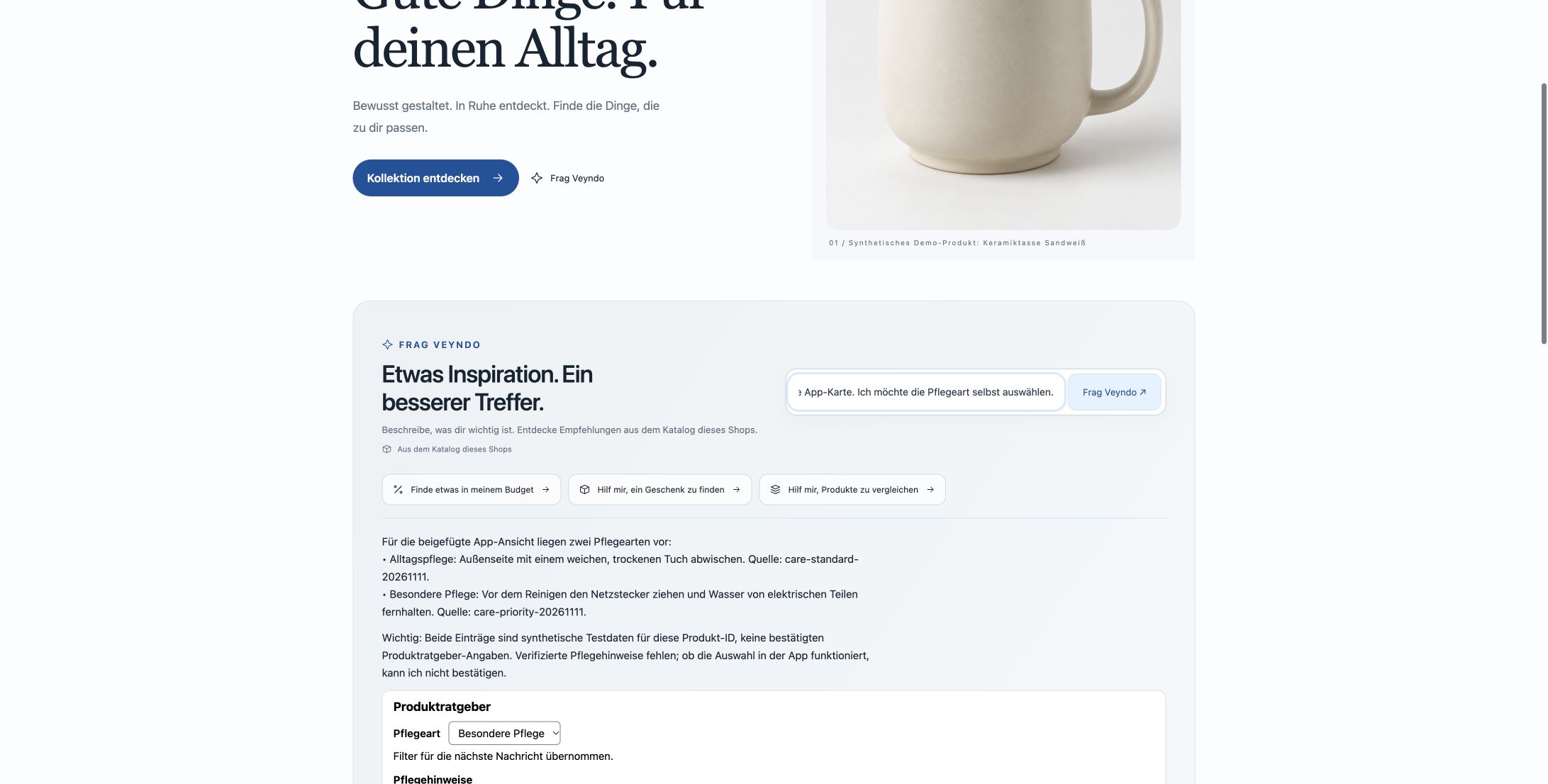
The Lumen email app has received the tested order events, but sending remains disabled in test mode and its sender and transport are unconfigured. That is the remaining external mail-delivery prerequisite, not a successful mailbox receipt.
Current stock in original Storyfront
The original renderer now separates current native availability from published design. Exact tenant/channel SKU reads set its existing sold-out state. A one-second coalesced read and stock-aware HTML cache identity preserve the cached presentation without retaining stale purchase controls. Native variant admission and minimum purchase quantity are included. Core still validates stock and commits the eventual order.
The private package passed both application CI runs, including the actual
native image boot with original Astro applications and isolated PostgreSQL
databases. The Experience candidate honest-holiday-8885, source 643010e5,
passed against all eight previous hosted artifacts and its unchanged storage
schema before rollout. After deployment, the same candidate matched all eight
running services and their exact source/schema inputs. The checked composition
lock now records that accepted image.
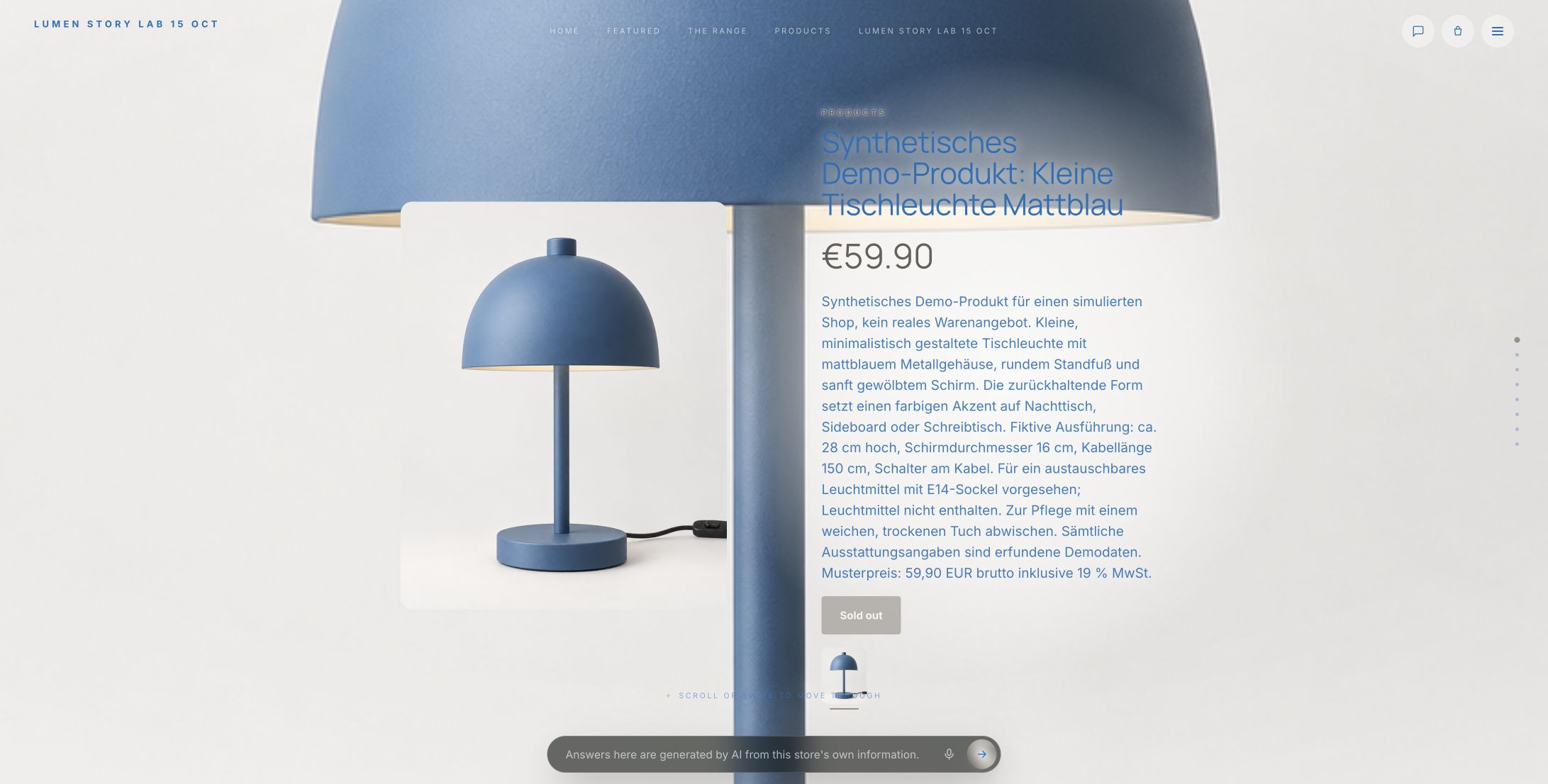
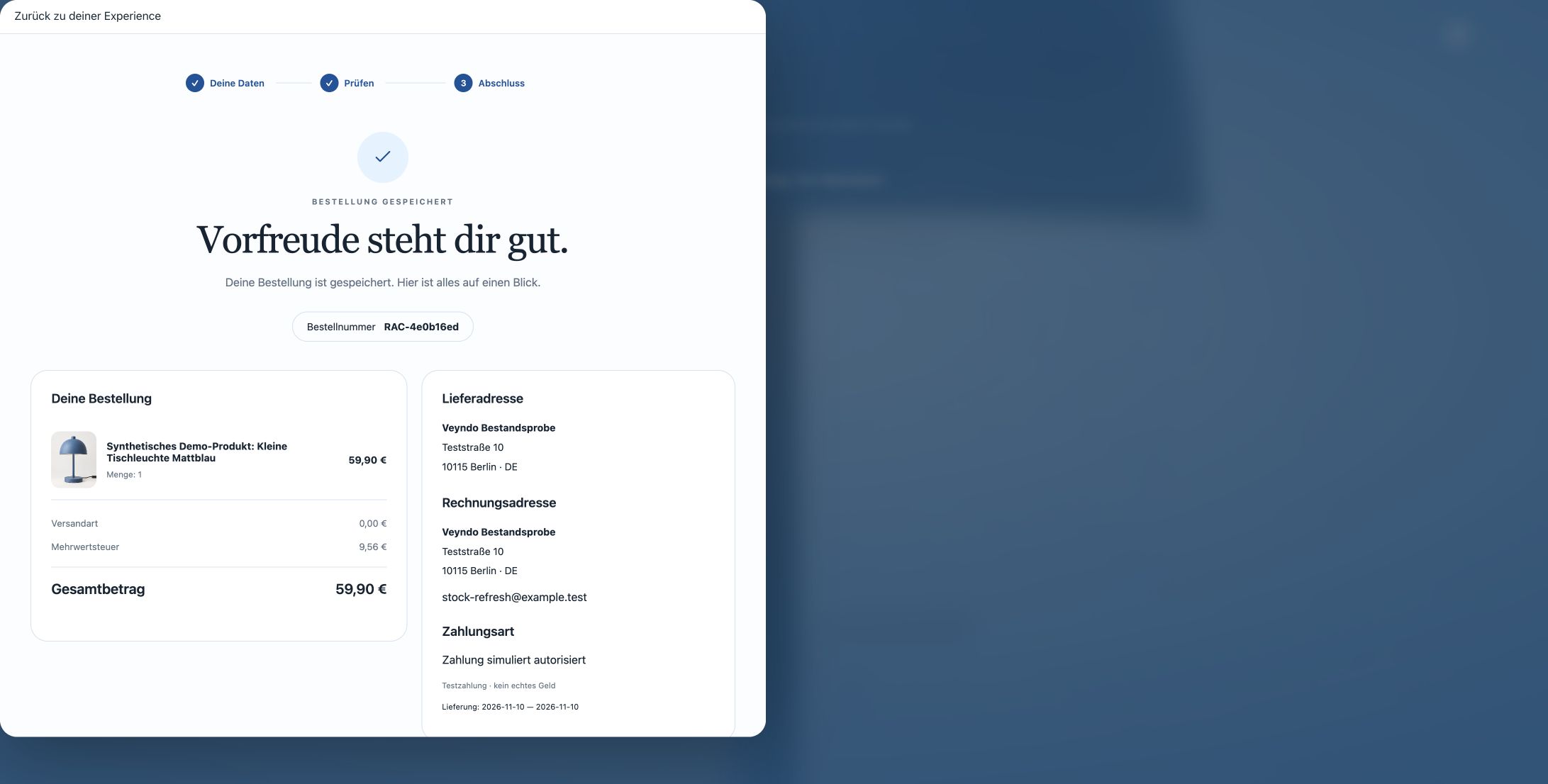
The public original Storyfront browser journey on 11 November checked stock
zero with a disabled purchase control, then added exactly one synthetic unit
through the native product editor. Reloading the same product route without
query parameters enabled purchase without a Storyfront republish. Embedded
demo order RAC-4e0b16ed stored the German product name and EUR 59.90 total.
Return and full reload kept the original bag empty. The native product moved
from revision 30 through restock revision 31 to purchase revision 32 with stock
zero. The same reloaded Storyfront route again disabled purchase.
Studio showed the exact order, its order.placed Flow entry and the manually
created German invoice INV-00000002. The existing Google account renewed its
Experience session and returned to Core Studio. Its earlier expired Studio
view resumed into the original order after choosing the same account.
This journey used simulated payment and an example.test address. It did not
establish provider capture, invoice PDF contents or actual email receipt. A page
already open refreshes availability on its next render, not through a stock push.
Shared cart contract on Northflank
Core efe8928f, build makeshift-shade-6829, completed the normal snapshot,
migration and deployment workflow on 10 November. Commerce now owns the
persisted Item/Cart contract. Native POS, B2B, App and checkout contexts retain
their concrete types. Tenant identity, cart credentials, revision and the
atomic order transaction remain with Core.
Seventeen Commerce unit tests and six targeted PostgreSQL integration suites passed. They covered checkout handoff/review, App quote hooks, POS, B2B and UCP, including legacy stored carts, receipt replay and current purchasing authority. Workspace lint, dependency boundaries and the existing formal policy checks also passed.
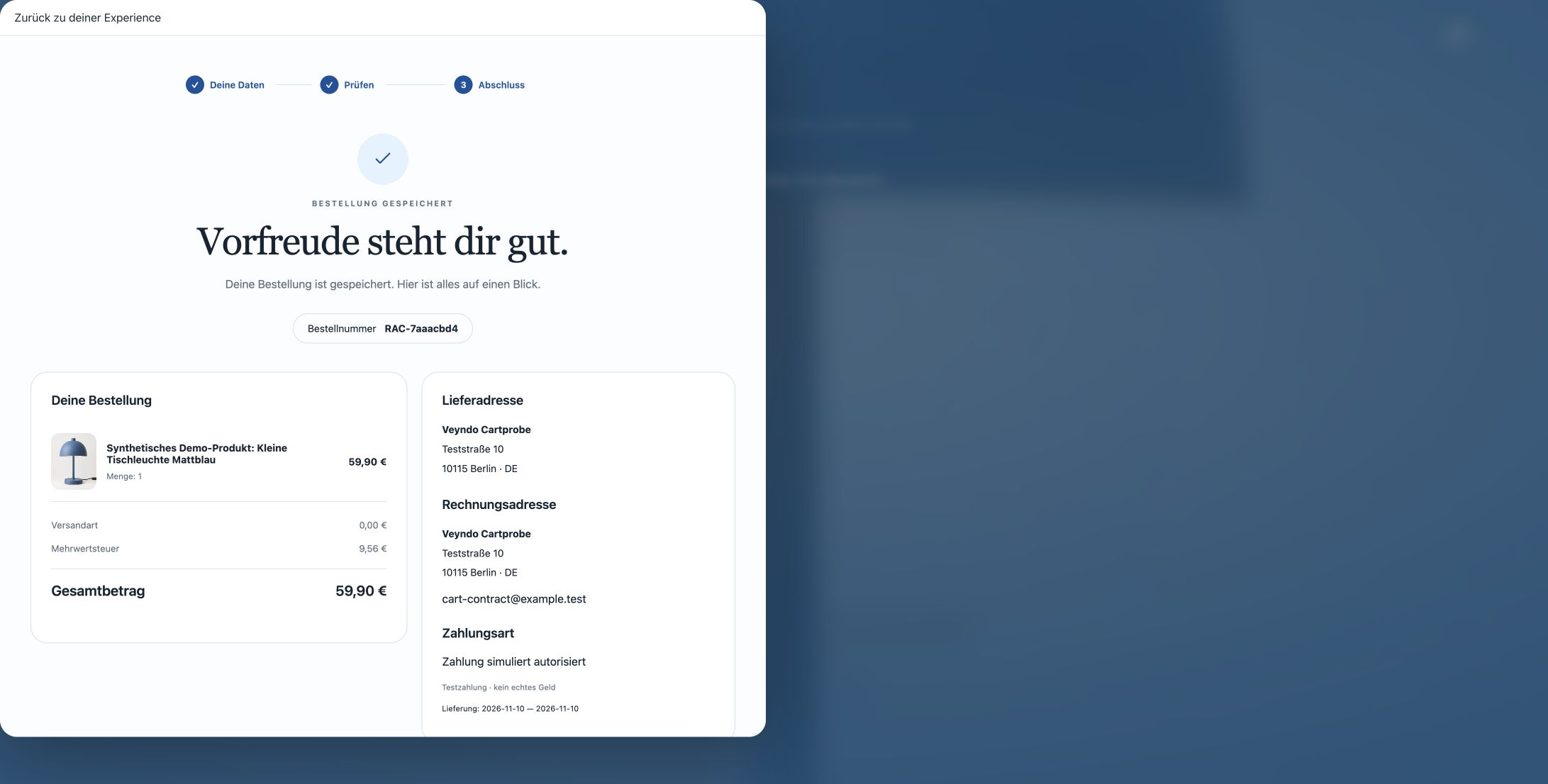
The public Storyfront iframe completed demo order RAC-7aaacbd4 for EUR 59.90
after rollout. Its German product name and total matched the native Admin order.
Returning to the Experience emptied the originating bag. The bag remained empty
after a full reload. The Admin showed the order.placed Flow entry. The shop's
demo article had zero stock before the test. The first purchase was rejected for
insufficient stock. Exactly one synthetic unit was added through the native
product editor, and the successful purchase consumed it, returning stock to zero.
This purchase used simulated payment and an example.test address.
The separate candidate manifest passed against the previous eight running artifacts before migration. After deployment, all eight services and their pinned source/schema inputs matched the same candidate file. That file was then promoted to the composition lock. Automatic invocation by the deployment workflow remains open. Release procedure.
Shared product contract on Northflank
Core build astute-chance-6558 from ab340128 completed the normal
snapshot, migration and deployment workflow on 10 November. The native
catalog now hydrates the Product and Tier DTOs from the transport-free
Commerce crate. The existing Context Tier path reexports the same type.
Fourteen Commerce unit tests and 1,446 comparisons with the original Shopware context and tier behavior passed locally. The PostgreSQL catalog and automation suites completed native orders and invoice Flows while checking tenant isolation and private fact redaction. Twelve checkout handoff checks also passed, including lost browser notification recovery, native/transferred quote equality, original order replay and registered iframe origins.
After the hosted rollout, Core health, the Lumen Storyfront page and its native product endpoint returned HTTP 200. The public product response excluded internal automation facts. The eight running component builds and their pinned schema inputs matched the updated composition lock. Domain owners · Shared Rust contract.
App creation, publication and restore
Five targeted integration suites passed against local Core and a fresh PostgreSQL database. A generated app went through a private draft, real records and selected publication. A native order activated the configured Flow. App restore retained installed packages and data. The merchant and shopper assistant paths exercised the admitted app views. Fifteen editor component checks also passed. A separate Chromium run published two versions of a Product Advisor app and restored the first design as a new version. The private test record remained private across all three publications. Test scope and open hosted checks.
Flow contracts and sales channels
Core 636a05b8 brought the typed Flow validation result to Northflank. The
public shop exposes catalogue search over MCP. Its anonymous tool list
excludes Flow validation, and the signed-in Lumen Studio API Explorer
discovers the validation result schema. The published SDK 0.4.1 prerelease
was installed from its release package and tested against Core and PostgreSQL with a
merchant test account. Validation reported the checked revision, rejected an
outdated draft and left both saved Flows and jobs unchanged.
Contract and example.
In local PostgreSQL tests, the native register recorded one cash order and one stock change across repeated submissions. A B2B buyer negotiated an offer, obtained approval and completed the purchase through UCP. Shipping kept the order total, stock and invoice consistent across split shipments and retries. The independent Marketplace gateway imported a paid order with one stock movement, one Flow and an invoice. The separate EDI gateway processed EDIFACT, UBL and cXML into scoped requisitions. A requisition completed in native B2B checkout, and a revoked credential prevented further imports. Marketplace provider requests used local fixtures. These tests covered separate shops. A further PostgreSQL test put the web shop, cash register and Marketplace callback in the same shop and made them compete for the last unit of one product. One order committed, both other routes rejected the sale for insufficient stock, and the winning request returned the same order on replay. The connected Marketplace suite retains that regression. The same shop then restocked two units, imported a UBL requisition for the same SKU, completed native B2B checkout and split the shipment into two single-unit parcels. Repeating checkout and the split preserved the original order, total, parcel quantities and zero remaining stock. Marketplace regression. Complete shop acceptance.
Core d80a55b5 advertises the current B2B negotiation guide
in the public UCP profile. The advertised guide and the demo storefront,
catalogue and MCP discovery responded after the Northflank rollout.
Private Automation preview on Northflank
Core's build now links the rule library pinned to the private preview's source revision. A local comparison found matching results in 440 HTTP cases and three MCP calls. Source ownership and checks.
The independent Automation service runs privately alongside Core. It evaluates
supplied rule facts through HTTP and MCP. The deployed image passed the container
tests. In Northflank, health, OpenAPI and unauthorized access checks passed.
An isolated Northflank shop then checked 48 authenticated calls per
transport with a scoped automation.read key. HTTP and MCP matched on
eligible and ineligible rules. Both rejected the next call after revocation.
The live Lumen demo subsequently returned the same match and no-match
results through both transports with a shop-scoped read key. Both returned
401 immediately after its revocation.
Deployment and acceptance.
Private Checkout live in the Lumen test shop
Northflank routes signed-in Lumen buyers using the demo payment through the
private Checkout service. The original Storyfront iframe created and confirmed
its session through the two same-origin Store API endpoints. Order
RAC-694ba533 cost EUR 59.90. The original Storyfront bag was empty after
return and reload, and the demo lamp's stock moved from four to three.
A separate native Store API purchase returned the same order ID when its confirmation was repeated. Stock moved from three to two. The completed API cart retains its line items for the receipt.
The native browser and the original Storyfront iframe then each completed a
EUR 59.90 Shopware Payments purchase using the actual PayPal Sandbox. Both
used the private Checkout route. The native cart was empty on return, and the
Storyfront bag stayed empty after a full reload. Studio then refunded the
original native order RAC-a31ce698 and Storyfront order RAC-2e7cfc2a.
Each EUR 59.90 refund showed a completed PayPal Sandbox provider record
and the original payment showed refunded.
The default order and capture Flows wrote internal notes for those two
orders. A separate live demo payment created order RAC-7048dee8 and its
scoped order Flow generated invoice INV-00000001 automatically. Repeating
confirmation returned the same order and the lamp's stock moved once, from
one to zero. Lumen has the Email Delivery app installed. The live app
showed an empty sender address and SMTP server. A configured sender and
transport are required to verify the Connector receipt and delivery to a
reachable mailbox.
Pilot setup and verification. The
ordered release checklist
tracks the remaining pilot, composition, hosted load and external integration checks.
Independent Connector image live
Northflank runs Connector build mint-meeting-7629 from the independent
veyndo/connectors repository at fc36cad. One instance passed its
checks with zero restarts. The deployed service retains the existing Core
profile and provider configuration. The dedicated Connector database was
exercised in the local composition below. A hosted order mail through the new
image still needs an authorized test shop and a receipt from the provider.
Connector deployment and verification.
In a local run, the same order passed through private Checkout, Core, the separate app worker and the independent Connector. The client discarded the first confirmation body and recovered the order after a Checkout restart. Core showed one stock decrement and one invoice, and the SMTP fixture received one mail with that order number. Reproduce the composed journey.
A separate local run followed a Shopware Payments fixture purchase through the same services. Verified capture triggered the invoice and order mail. The Connector receipt matched the message ID received by SMTP. The refund and its replay preserved the original order and payment attempt. The hosted Lumen checks cover both Sandbox refunds and an automatic invoice after a separate demo payment. Provider acceptance and arrival of the hosted order mail are still open.
Pinned purchase recovery rehearsal
Fresh builds of Core, Checkout and Connector started on a disposable PostgreSQL cluster with the independent app worker. One order survived a discarded confirmation and Checkout restart. While independent confirmation and the worker were paused, the native route accepted a distinct second order. The worker restart generated its invoice and SMTP fixture mail. Re-enabling Checkout and retrying the first confirmation preserved both orders and stock effects. A separate payment fixture also passed capture, invoice, mail and refund. A separate Northflank job reproduced these tests with the checksummed executables from the running Core, worker, Checkout and Connector. It completed 48 purchases per route with one invoice and one loopback SMTP message per order. Purchase p95 was 430.84 ms native and 3195.01 ms independent, including 27 retries across 11 independent orders. The separate service comparison below measured both demo routes. Provider callback capacity remains open. Source pins, schema fingerprints and hosted results.
The Northflank builds used in this rehearsal for Core, the app worker,
Checkout, Knowledge, Connector, Payments and Automation have recorded
image manifest digests. The original Core and App Worker builds ran as
separate containers in the private Northflank release lab. Core booted
against empty PostgreSQL. Two simulated native purchases each preserved
one order and one stock decrement after a confirmation retry. The Worker
generated one invoice per order, including after a stop and restart. A second
fresh database run enforced distinct restricted system and tenant roles.
Startup rejected a runtime role with TRUNCATE, and the isolated shops
could not read each other's orders or receipts. Checkout, Payments and
Connector original images each started in a Northflank job. A local
purchase through the actual Payments adapter and separate Checkout,
worker and Connector recovered the same order, produced one invoice
and one SMTP message, and refunded once under replay.
Hosted image boot with restricted roles.
Payment replay and original image probes.
Payments build luminous-ink-2350 is live in Sandbox mode. It fixes
simulated invoice approval and retains the provider risk session check.
The complete Payments workflow passed, including saved methods and all
17 simulated methods. Release and verification scope.
Five original images together on Northflank
A private Northflank rehearsal ran Core, Checkout, Payments, the app worker and Connector as separate services with four test databases. Independent Checkout recovered the same demo order after restart, with one stock decrement and an empty next cart. A separate native payment used the Payments simulator. Its signed callback, two replays and repeated full refund preserved one payment, invoice and SMTP acceptance. The Connector receipt matched the SMTP Message-ID. These were API journeys with synthetic data. The public Lumen browser and PayPal Sandbox results are recorded separately above. Build pins, database roles and checks.
Matched checkout load with separate services
In Northflank, four original Veyndo images ran as separate private services. Each purchase route handled 48 simulated orders and 240 catalogue requests in a shop with 200,000 products. Both produced one stock movement, one invoice and one SMTP fixture acceptance per order. Confirmation p95 was 590 ms native and 3.11 seconds through independent Checkout. Twelve independent purchases retried, with 17 retries in total. Method, build pins and results.
In a subsequent local comparison with a fixed 180 ms service delay, a one-second confirmation admission window reduced p95 from 1,795 ms to 677 ms and eliminated eight retries caused by local wait timeouts. Both arms verified 48 orders, invoices, stock movements and SMTP acceptances. Local method and timings.
The matched follow-up across separate Northflank services used the same Core image with both wait settings. Confirmation p95 fell from 2.99 s to 1.07 s and local wait timeouts from 16 to zero. The median rose from 595 ms to 977 ms. Two requests still retried after cluster quota refusals. Across both runs all 96 orders kept one stock movement, invoice and SMTP acceptance each. Hosted method and timings.
Signed payment callback load
An isolated Northflank comparison ran 24 simulated approvals with eight concurrent clients through the separate Payments service. Draining ready notifications reduced capture visibility p95 from 16.46 s to 4.77 s. Each arm recorded 24 distinct orders, capture IDs and inbox events. Replaying every approval preserved the original bookings and stock. This measures the signed service callback path with demo funds. Builds, timings and verification.
Mixed shop traffic and app-worker recovery
An isolated local Core with 200,000 synthetic products accepted 48 simulated purchases while serving catalog and agent requests. Core committed an order while the private app worker was stopped. After restart, every order had one invoice and one SMTP delivery through the independent Connector. Purchase retries returned the original order IDs and stock moved once per order. Reproduce the test and see the timings.
The same local load also passed through independent Checkout. All 48 orders had one stock decrement, one invoice and one mail. Eight confirmations needed the server's retry interval. Checkout p95 was 10.05 seconds with those waits, compared with 51.77 ms on the native route in the paired run. Independent Checkout load.
The local follow-up reduced the retry interval for independent Checkout admission from five seconds to one. Confirmation p95 fell to 2.04 seconds in the same workload, with one order, stock decrement, invoice and SMTP delivery per cart. Follow-up measurement.
The bounded relay queue and explicit lease handoff reduced local independent
confirmation p95 from 2,047.84 ms to 129.65 ms in a matched 48-order test.
All 48 purchases completed without a retry. Median latency went from 41.62 ms
to 107.22 ms. Each purchase still produced one order, stock decrement, invoice
and loopback SMTP delivery. Comparison and scope.
Core 9ed1c0bb is live on Northflank. The isolated comparison using
the running Linux executables reduced independent confirmation p95 from
4,078.00 ms to 1,717.01 ms and retries from 30 to 9. The native control
completed at 298.18 ms p95 with zero retries. All three runs produced one
order, stock decrement, invoice and loopback SMTP message per purchase.
Hosted versions, method and results.
Knowledge source inventory
The independent Knowledge service 0.5.0 can list imported products and private documents with their source revisions and withdrawal state. HTTP, MCP and the JavaScript example use the same scoped operation. The existing database index serves the pages. Core catalog and checkout do not call this inventory. In the local composition, a native purchase completed while Knowledge was stopped. The queued product update was delivered after restart and the inventory showed the recovered revision. API and example.
Local lifecycle checks also restored Knowledge into a fresh PostgreSQL
database and rebuilt search. A separate Core run changed the embedding model
from three to five dimensions and verified Qdrant indexing, document edits
and archive after restart. The rolling test kept two Core workers active
and verified a newer revision could not be replaced by the old worker.
Search stayed available while 150 products and a concurrent edit were
indexed. Core 8c9baf80 is live on Northflank with the current model.
The existing deployment completed its backup, migration and rollout.
Afterward, the public demo catalog and MCP discovery returned their
expected data. The live provider model change remains a separate check.
Lifecycle checks.
The local Knowledge acceptance rejected a wrong database signing key at startup. While PostgreSQL refused connections, readiness returned 503 and liveness stayed up. Readiness recovered once the database accepted connections again, with the same service process. Readiness and authenticated rollout checks.
A local run also used Core's current integration and app keys for a single live shop. A catalog edit reached the independent Knowledge database and the read key returned current evidence. Both revoked keys and keys from a different shop were denied. A withdrawal rejected after revocation stayed queued, and the next delivery after key rotation removed it from search.
The initial Core identity rollout used Northflank build fast-winter-7173
at d3a2042. That instance
passed its readiness check with zero restarts. All 48 public health samples
succeeded during rollout. Afterward, the native demo and Storyfront loaded,
and an isolated demo cart passed quote, change, replay rejection and cleanup.
Across 12 requests each, median client times were 30 ms for Core health,
72 ms for the native demo and 65 ms for the Lumen Storyfront landing page.
Capacity testing uses a separate load run.
One private Knowledge replica is running on Northflank with its own PostgreSQL
database, a restricted login and enforced row security. Through a private
tunnel, liveness and database readiness returned 204, OpenAPI returned 200
and an unauthenticated source request returned 401. Core and the app worker
have the same pinned private catalog app destination. Core's identity
endpoint is scoped to Lumen. The running Knowledge service reached the
broker and rejected an unknown token. The installed Lumen catalog app has
separate short-lived keys for event delivery and for reading current product
content from Core. Both the Core callback and the private Knowledge refresh
returned HTTP 200. Studio recorded first-attempt delivery of two live
product.updated events (#926 and #927) for the demo lamp, including
the restoration of its original description at product version 28.
A separate, expiring evidence-consumer key read Knowledge revision 3 by its
veyndo: source ID over HTTP and MCP. Search returned the restored German
description with the same content hash, and the current-evidence check accepted
it. The reader could not list documents. After revocation, its next request
through each transport returned 401. Core product version 28 and Knowledge
source revision 3 are counters owned by their respective services.
Core identity setup.
The isolated Northflank outage rehearsal paused Knowledge while Core and the App Worker remained active. A simulated purchase and its replay produced one order, one stock decrement and an empty next cart. The queued catalog change arrived after restart. HTTP and MCP verified revision 2 and rejected the revoked read key. Hosted outage rehearsal.
Knowledge database recovery
The standalone PostgreSQL 17 acceptance restored a source archive into a fresh database with a separate runtime login and signing key. The test rebuilt lexical search, compared localized evidence and graphs, checked withdrawals and denied the old key and a foreign tenant. This was a local recovery test. Recovery procedure.
App cards during replies in Studio and the shop
In a local Chrome test with Core, PostgreSQL and a controlled model response, Studio showed the private merchandising card before the final answer. The merchant filtered the card and prepared an editable follow-up while the model was waiting. The same frame and filter remained when the answer arrived. The original actor could see the progress. Another administrator in the same shop and an unrelated shop could not access the run. The status contained only the card reference and tool arguments. The browser made one initial app read through the current MCP permissions. Studio progress.
In a local Chromium test with Core and PostgreSQL, the assistant's final response waited for the test to release it. The shopper could see and filter the Product Guide before that release. The filter and iframe stayed in place when the text arrived. With one inference slot per shop, a second assistant request received HTTP 429 while the existing app filter still worked. The same API returned JSON when the client asked for it. Shopper stream.
External SDK example with an MCP App and Checkout
Connected Shop is available from the public SDK repository. The example runs an external Node host with SDK 0.4.0, the Core catalog, the installed Product Guide MCP App and independent Checkout. A fixed question opens the guide without requiring a model key. The browser can filter its public records and explicitly confirm the reviewed simulated order.
On desktop and mobile, Core recorded one order and one stock decrement per purchase. The mobile run dropped the successful Core confirmation response before it reached the example. The host read back the original receipt, and reload preserved it. The same test rejected a different product requested by the iframe and an unrelated origin on confirmation. Setup and test scope.
Variant purchase from an external host
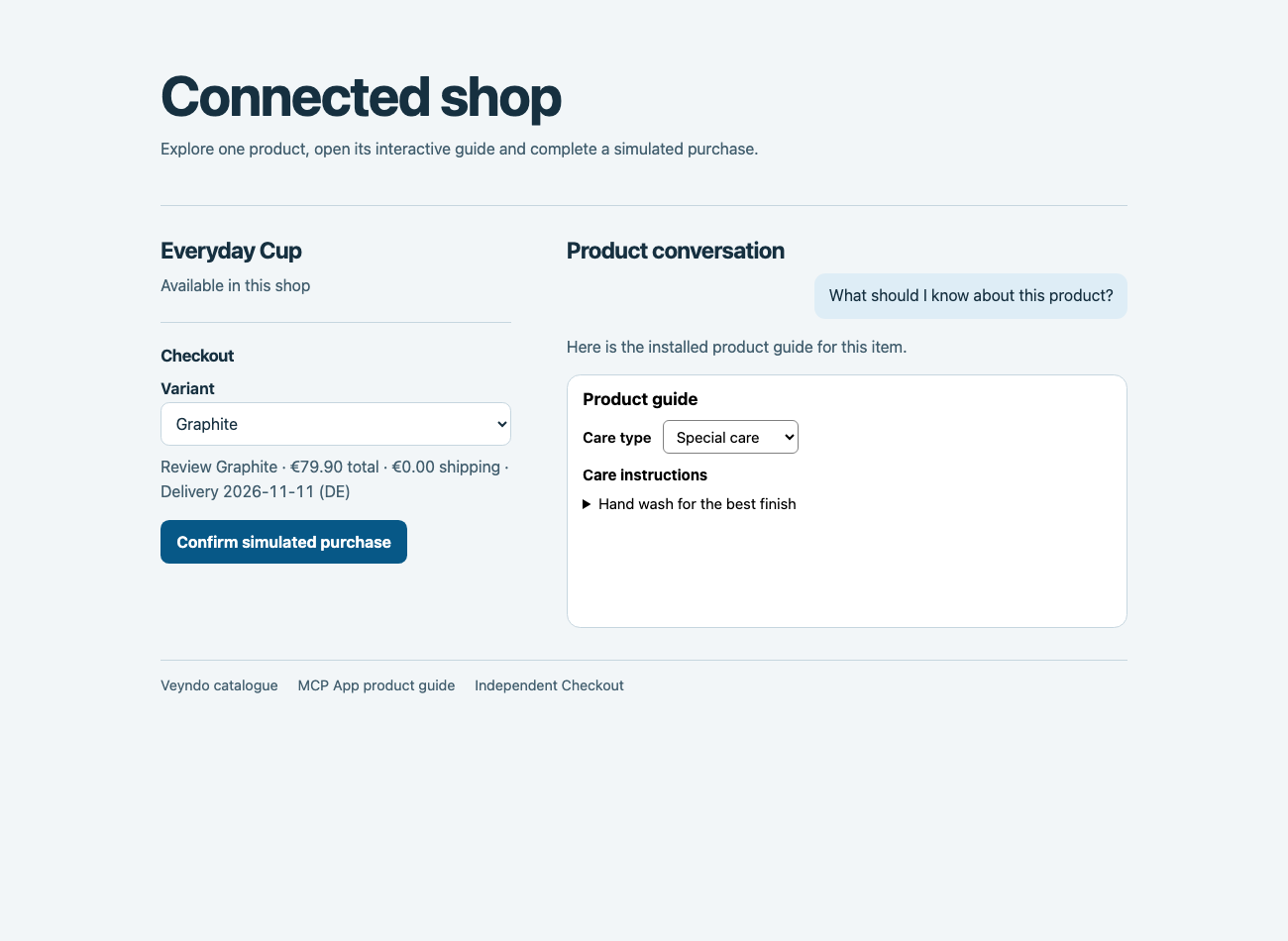
The public Connected Shop source now supports a product family. In an isolated run on 11 November, Chromium opened the installed Product Guide and filtered its care records on desktop and mobile. The example host quoted Brass at €64.90 and Graphite at €79.90 using Core's cart totals and delivery dates. Silver was out of stock. Changing the selection cleared the displayed offer. The host refused the old review after a fresh quote and confirmed one Graphite unit per session.
Core and independent Checkout used separate PostgreSQL databases. The mobile run discarded the successful confirmation response. The host retrieved the original receipt and reload preserved it. Core had two orders and two Graphite stock decrements. Brass and Silver stock were unchanged. Payments used the demo card. The browser used the MCP App and the example's own checkout controls.
Desktop quote · Mobile receipt.
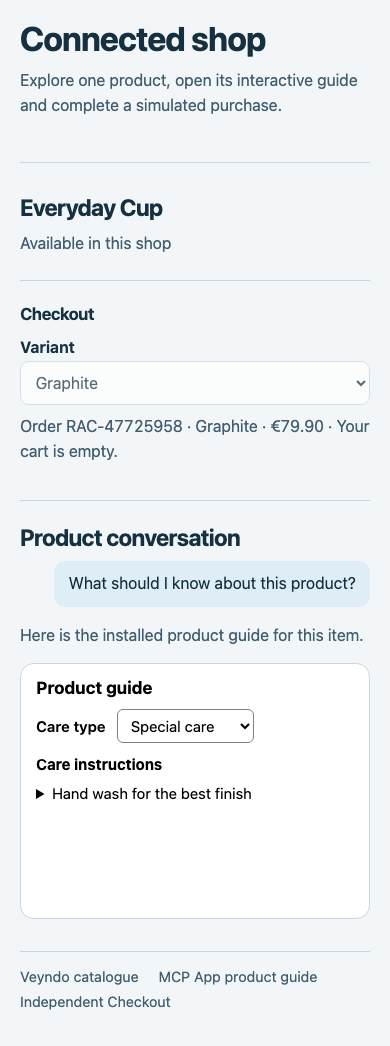
OpenUI variant checkout
The Connected Shop example uses OpenUI to place the purchase controls and the filterable MCP App. In the 11 November browser tests, desktop showed the purchase panel first and mobile showed the guide first. The optional provider path received a controlled model response. Core, independent Checkout and their separate PostgreSQL databases ran locally with simulated payments.
The host rejected the previous Brass offer after reviewing Graphite and confirmed one Graphite unit at €79.90 in each browser session. The mobile run discarded the successful confirmation reply. The same order receipt returned after recovery and reload. Core recorded two orders and the Graphite stock fell by two units. Layout output could choose panel order only. The live provider call remains unverified for this example.
Mobile receipt with the guide first.
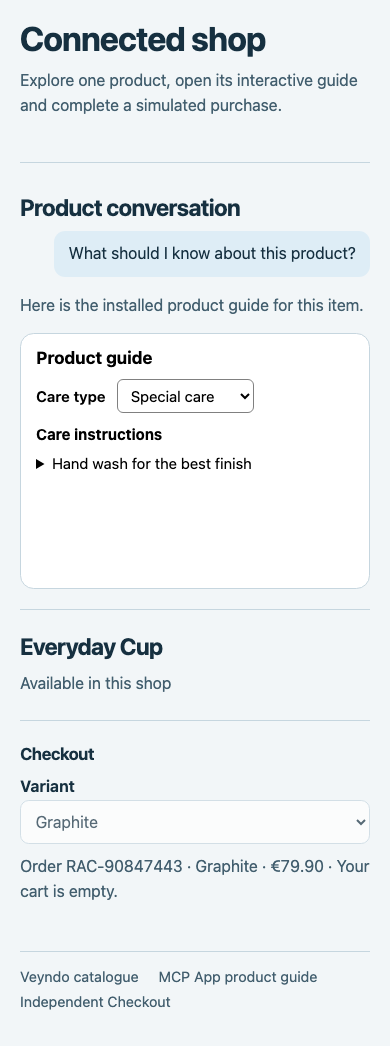
A2UI workspace adapter in SDK 0.4.15
The SDK package exports a versioned A2UI adapter. The official protocol processor accepted an admitted layout assembled from two independent MCP HTTP fixtures. Their reads used separate scoped clients. Unsupported renderer capabilities returned panel references, and a context change rejected the previous layout until rediscovery.
The Connected Shop browser run used the SDK adapter with the official Lit renderer. It confirmed the Graphite variant, recovered the original receipt after a lost confirmation response and kept the empty cart on reload. The receipt also survived switching to OpenUI and falling back after an invalid A2UI message. The purchase ran against local Core and Checkout with separate PostgreSQL databases, simulated payment and a controlled model response. Mobile receipt.
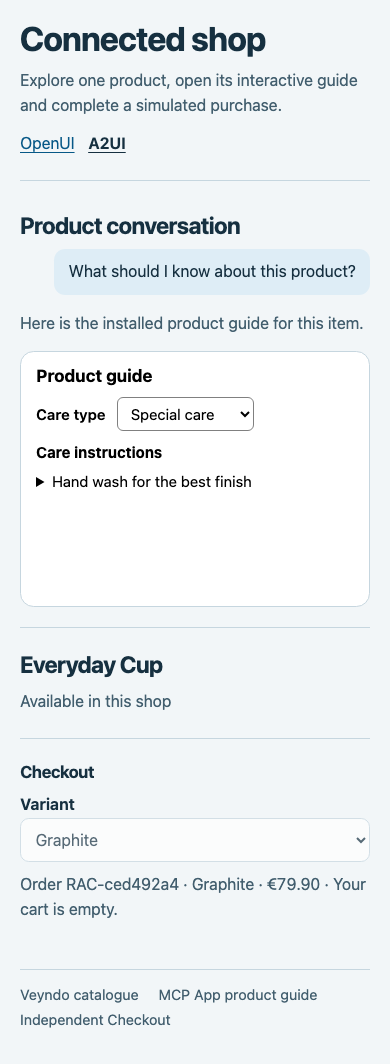
Connected Shop with OpenUI and A2UI
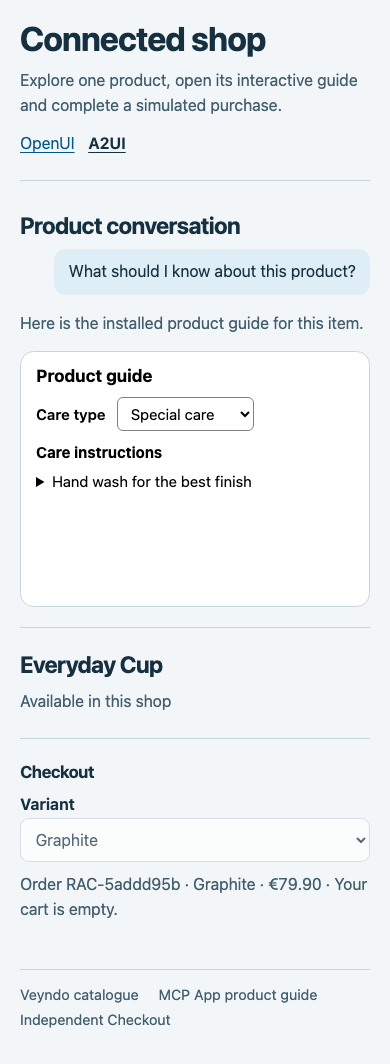
The SDK example offers two renderers for one panel definition. Desktop Chromium ran OpenUI. Mobile Chromium ran the official A2UI Lit renderer with v1.0 JSON. Both filtered the installed Product Guide, changed the reviewed variant from Brass to Graphite and confirmed a simulated purchase for €79.90 with delivery shown at review. An outdated offer was rejected. Both showed an empty cart and the same receipt after reload.
The mobile run lost its successful confirmation response and recovered the original receipt through independent Checkout. The two purchases produced two orders and deducted two Graphite units. Core and Checkout ran locally with separate PostgreSQL databases. The layout provider returned a controlled response. The example runs on loopback and the platform-wide A2UI adapter remains in the component plan.
MCP App conversation views and independent Checkout rehearsal
Core image gorgeous-seat-2912 from
bb95542
is live on Northflank. The workflow built that commit, created the PostgreSQL
snapshot, ran vendune-migrate successfully and started the new Core. The Git
trigger now follows veyndo/veyndo on main.
The public app view served the new filter control. In an isolated cart in the public demo shop, preview returned a price and delivery date and left the cart empty. The single external probe measured 85 ms for preview and 103 ms for confirmation. Confirmation added one unit. Changed quantity and a replay of the same revision each returned HTTP 409. The test then emptied its cart. The Nord Atelier SDK excerpt also ran against the public demo. These checks did not install an app in a hosted shop or apply a merchant proposal there.
The next app interaction was verified in local Chrome with Core, PostgreSQL and a simulated model endpoint. The storefront and Studio each carried an applied filter into an existing editable draft. Both sent it only on the next explicit submission. A forged frame message with extra content was rejected in both views. Chat context.
The first MCP App rollout used Core image alleged-degree-4325 from
e133b155
on Northflank. The instance passed readiness with zero restarts.
Studio, the native demo and the Storyfront demo returned HTTP 200. The public
demo shop negotiated MCP Apps with a compatible client. A text-only client
received the ordinary MCP capabilities and a request for an unknown view was
rejected.
The Product Guide 0.1.1 follow-up adds an app-declared filter in the conversation. The isolated Core and PostgreSQL test exercised the public and private reads, retained the original product filter, and rejected unauthorized actors. In Chrome, the mobile storefront and desktop Studio each filtered and reset their own app result.
The local follow-up exercised native actions in both chats. A shopper selected a product variant, reviewed the server-calculated price and delivery, and added the variant once. A merchant opened an app-linked stock proposal, compared 80 with 79, approved it, and read back 79. The PostgreSQL fixtures rejected a changed price, a replayed cart revision and approval by another administrator. Interaction contract.
An installed app can show its own table or expandable cards inside a Studio or native storefront answer. In the isolated browser run, the frame loaded the next page of records. The HTTP and PostgreSQL fixture checked both assistant paths with a synthetic model and rejected foreign-shop, private-scope and deactivated-package requests. The public protocol check did not install an app in a hosted shop. Package guide.
The local Checkout composition recovered a simulated purchase when the native
host's response was dropped after commit. It returned the original receipt after
restart and observed one order and one stock allocation. Under four quote
workers and four concurrent catalogue readers, 192 requests per quote path
had zero errors and p95 of 13.1 ms direct versus 13.6 ms composed. The catalogue
and native quote stayed available with Checkout stopped. These are local
fixture measurements. The opt-in browser route
is merged. Desktop and mobile Chromium used it with a signed-in buyer and
simulated payment. Recovery preserved the receipt and the empty cart after
reload. The local Storyfront checkout also signed in inside the iframe, placed
the order through Checkout and kept the originating bag empty after return and
reload. When the confirmation response and iframe message were both lost, two
transport attempts resolved to one receipt, one stock decrement and one
order.placed event.
The new same-origin route passed locally in desktop and mobile Chromium,
using the real Core and Checkout processes and separate databases. The
native storefront and embedded Storyfront controller recovered the original
receipt when confirmation was lost. Both showed an empty bag after reload,
with one order, one stock decrement and one order.placed event per
purchase. The local Storyfront fixture also
discarded the iframe completion message. Checkout kept its private listener.
The relay uses separate request capacity so waiting requests leave room for
Commerce callbacks. An isolated PostgreSQL check filled all four shop relay
slots. The next relay request returned HTTP 429 while the native cart still
responded. Local PayPal provider responses also exercised approval, capture
and full refund on the original payment attempt in both browser journeys.
Configuration and verification.
Northflank runs Checkout image puffy-soup-2325 from eaa34f2 with one
ready private replica and zero restarts at verification. Its separate database
enforces row-level access. The restricted login authenticated and could not
read the database signing key. The temporary administrator connection was
removed from the maintenance job after installation. Public shops still use
the existing Core checkout. Hosted native and Storyfront purchases, provider
payment and refund through the independent service remain open. The earlier Core image
max-tendency-8164 from 6edb6a8
rolled out with one ready replica and zero restarts. The browser switch remains off.
Checkout verification and rollout.
Experience image guided-eggs-5114 from 465f0a9 now serves original
Storyfront a57ed0e on Northflank. In the public Lumen test shop, closing and
reopening checkout kept the demo product in the bag. The simulated purchase
RAC-2d6858a4 for EUR 59.90 returned to the Experience and the bag stayed
empty after reload. A second simulated purchase, RAC-e2a6e476, recovered
after the browser deliberately dropped the completion message. It made one
order request and left an empty bag after reload. Both purchases used the
existing Core checkout.
Public Storyfront acceptance.
The local PayPal Sandbox composition exercised the built-in PayPal adapter and the installed Shopware Payments adapter using synthetic provider responses. It recovered the original attempt after a lost confirmation, verified provider approval and reconciled capture and refund on that attempt. A switch to Live after the quote left order, stock and payment job state unchanged. The local browser run also verified provider-frame approval, full refund and an empty bag after reload in native Veyndo and Storyfront. Closing Storyfront while payment was pending preserved the bag and reopened the original order. The hosted Lumen pilot later verified Sandbox capture in both browser entry points. PayPal Sandbox setup and local test.
Orders and shipping in agentic workspaces, 9 November 2026
The initial Orders workspace release used Northflank image pure-knowledge-5648 from
cb66af0.
The new instance passed readiness with zero restarts and the previous instance
terminated. Public Studio and the demo shop served the new frontend assets.
A public assistant request opened the comparison for two catalog products with
59.90 EUR and 24.90 EUR prices. Its product link opened the native detail page.
A separate disposable basket added one item, returned a server total and was
cleared. Anonymous access to private Knowledge remained denied.
Studio can render a reviewed Orders view with current shipping policy using OpenUI and native domain permissions. An independent example pairs Commerce and Knowledge using scoped SDK reads. Local service tests exercised a real test order and policy, including revocation and a foreign Knowledge identity. The storefront compares catalog products and opens the native product page for configuration and purchase. The adapter and hosted acceptance matrix remains tracked in Agentic interfaces.
Commerce host ports for independent Checkout, 9 November 2026
Core now supplies quote, simulated confirmation and receipt recovery from its existing Commerce transaction. The native storefront and Storyfront still reach Commerce directly. The independent Checkout service uses one host request per operation and keeps only its session metadata in its own database.
The independent service has also passed a local purchase using the native HttpOnly buyer login. Core issued a five-minute Checkout grant and rechecked the underlying session on every use. The two Rust services used separate PostgreSQL databases, with enforced system and tenant roles for Core and a restricted runtime role for Checkout. Replaying confirmation kept one order and one stock decrement. The grant stopped working at logout, and a fresh login recovered the same receipt. Buyer identity setup.
The native storefront's existing checkout now has a local opt-in path to the separate service for signed-in simulated purchases. Chromium exercised the actual shop on desktop and mobile. The mobile run recovered the original receipt after the confirmation response was dropped. Both runs showed an empty bag on return and exactly one stock decrement.
That rollout used Northflank image wiry-spirit-4983 on Core and the private
app worker. It was built from 7ce9217c, with the same source tree as merged
release f8cdece8.
Core passed readiness with one replica and zero restarts. The private app
worker started with its dedicated role and sampled its queues.
| Public simulated journey after rollout | Observed result |
|---|---|
| Core host API | RAC-4c01a1f4, 59.90 EUR, one stock decrement and the same receipt on replay and recovery. |
| Native storefront | RAC-f34fe74a, 59.90 EUR, empty cart after return and reload. |
| Embedded Storyfront | RAC-8991a90e, 59.90 EUR, empty bag after return and reload. |
Twenty public host quotes measured 84.1 ms at p95. The API confirmation took 116.4 ms and the receipt read took 40.9 ms. The Chrome confirmations took 301 ms in the native storefront and 373 ms inside Storyfront. These are client observations on demo shops, with one purchase per path. The Storyfront run used keyboard activation to add the product because pointer clicks did not add it at the tested viewport.
Local PostgreSQL acceptance combined both Rust processes with HTTP, MCP and the JavaScript SDK. A lost confirmation response recovered the original order after restarting Checkout. The company buyer test exercised current membership, approval and budgets, the resulting Flow and the invoice.
With concurrent catalog reads, 192 local quotes per path finished without errors in each of two runs. The first run shared the machine with other verification. In the isolated rerun, native and composed quote p95 were 76.5 ms and 88.1 ms, and catalog p95 was 21.6 ms and 23.2 ms. Core still returned quotes and catalog results while Checkout was stopped. These measurements use debug builds and a loopback proxy. The separately hosted Checkout process and configured provider acceptance remain open. Commerce host ports.
Native and embedded checkout compatibility, 9 November 2026
Two public demo purchases on the current Core used the simulated payment
method. The native storefront confirmed RAC-703fe454 and Storyfront
confirmed RAC-ca1fb71a inside its embedded checkout. Each showed the
German product name and €59.90 total. The originating cart stayed empty
after returning and reloading in both cases.
| Public Chrome observation | Time |
|---|---|
| Storyfront checkout click to visible contact form | 1,005 ms |
| Storyfront final submit to visible confirmation | 398 ms |
| Native final submit to visible confirmation | 248 ms |
Each row is one browser observation, including the test interaction overhead. The two purchases used different demo shops. The times describe those journeys and do not establish service capacity or a latency difference between the paths.
A separate PostgreSQL regression compared both entry points in the same shop. Both rejected an altered reviewed total and replayed the original order without another stock or event write. See the shared order contract. This step covers the compatibility analysis and simulated checkout. The configured provider callback and refund and independent hosted Checkout cutover remain separate acceptance items.
Connector composition and public response times, 9 November 2026
The private Connector 0.1.0 prerelease builds from its own repository. The Linux component run verified its non-root image with PostgreSQL, scoped HTTP and MCP, the SDK and a loopback provider. The native test against this separate binary ran Core, the app worker and the Connector with an independent database. Core accepted a simulated order before the worker started. Replaying checkout returned the original order ID. The worker finished one Flow, and the loopback SMTP receipt contained the order number. The same Connector binary also passed the existing Core database profile, nine provider fixtures and the offline import regression.
Before the cutover the hosted Connector ran Northflank build bold-table-9699
from d56d663. Its old build source is unlinked from the GitHub app.
The private Connector repository needs a scoped installation grant before
the hosted service can build the replacement. The existing Core and private
app worker remain deployed.
The public Storyfront demo kept one item after leaving the unpaid checkout. A second visit completed the embedded checkout with its simulated payment method. The German confirmation appeared, and the basket stayed empty after returning and reloading the Experience.
Four readers made 600 public requests over 150.6 seconds without an error. Each reader fetched one route per second and read the full response.
| Public route | p50 | p95 | p99 |
|---|---|---|---|
| Core health | 34.3 ms | 47.5 ms | 59.8 ms |
| Storyfront catalogue | 72.2 ms | 86.3 ms | 104.3 ms |
| Shop onboarding | 32.0 ms | 42.7 ms | 46.7 ms |
| Experience onboarding | 31.4 ms | 40.3 ms | 46.3 ms |
These are client-side times for four read routes at about four requests per second. The hosted test order's merchant-visible Flow trace and sustained traffic with active checkout and provider delivery still need acceptance. Connector guide · Component map.
Live Flow draft check and separate app worker, 9 November 2026
Core and the private app worker run Northflank build dashing-rain-5353
from 3a73ccd3. Its tree matched the merged release c24b5527. Core
deployment vendune-core-865b8bccb7 passed readiness with one replica and
zero restarts. The private worker deployment vendune-app-worker-849d988994
runs one replica and has no assigned ports. Core reports
app_worker_enabled=false. The worker reports process_role=app-worker
and samples both due queues. It uses the existing restricted runtime roles
and the exact approved private connector origin.
During the initial worker handoff and the final Core rollout, all 70 public health probes returned HTTP 200. After the final rollout, four parallel readers completed 60 timed requests. Median response times were 13 ms for Core health, 9 ms for standard shop onboarding, 9 ms for Experience onboarding and 48 ms for the Storyfront catalogue. These are short public checks around this release.
The public Storyfront demo completed an embedded purchase on the final build using simulated payment. The German receipt named the purchased product. Returning to Storyfront and reloading left the basket empty. A separate attempt for an unavailable item was rejected at checkout. The live storefront test did not have merchant access to the saved execution trace for the successful order. Worker queue samples and checkout were verified separately.
Studio uses POST /api/automation/flows/{id}/validate, and the SDK uses
the read-only MCP tool automation.validate_flow. A host without the
dedicated endpoint rejects the check. It cannot interpret it as a save.
The public route returned 401 without a merchant session. In isolated
signed PostgreSQL, HTTP, MCP and the SDK validated the same Flow without
saving or queuing it. The saved Flow branched, persisted a delay and created
one invoice. Tests checked actor revocation, replay and continuation across
a separate worker restart. The local Studio browser showed the successful
check with the same revision.
The daily verification checks each Rust image against its own build inputs. Tests for the visual editor, reports and coding agent follow their current entry points. The local frontend run passed all 1,018 tests and the unchanged coverage floors. Outbox migration checks run before the slower provider group.
Flow draft check · Worker rollout · Core source · SDK example · Image and UI verification.
Live app queue diagnostics, 9 November 2026
Northflank released build dizzy-milk-2262 from a2de14d as Core
deployment vendune-core-6478ccfff5. The deployed and merged sources
have the same Git tree. One replica passed readiness with zero restarts
and the previous replica exited. All 35 public health samples during
the rollout returned HTTP 200.
The active Core app process logged the due age sample from PostgreSQL. Both queues had no due queued rows in the startup sample. At that release, the dedicated worker was still paused and combined Core processed app work.
A simulated purchase in the public Storyfront demo completed through the embedded Core checkout. It displayed the German confirmation and the original basket stayed empty after returning and reloading. In 12 public reads per route before and after rollout, median times were 12 and 12 ms for Core health, 8 and 8 ms for onboarding, and 30 and 32 ms for the Storyfront catalogue. These are short public samples.
In isolated PostgreSQL, the service acceptance placed an order with Core's app lane off, delivered its event, restarted the app worker during a delay and observed one invoice from the resumed Flow. The combined Core then completed queued work after rollback. The same test checked that the worker emitted aggregate queue ages without tenant, order, app or credential data.
With six test purchases and exact replays, each local topology handled 96 catalogue reads without an error. The combined process measured 41.9 ms at the median and 77.1 ms at the 95th percentile. With the app work separated, it was 28.2 and 52.9 ms. Both runs produced six orders, stock decrements and invoices. These are local debug measurements, with four readers and four purchase clients.
Queue diagnostics · Source change.
Live Core with app worker handoff support, 8 November 2026
Northflank deployed Core build eminent-balance-6864 from 357b341 as
deployment vendune-core-64574dd986. The deployed and merged sources have
the same Git tree. The new Core reached one ready replica with zero
restarts and the previous replica stopped. All 35 Core health samples
during the rollout returned HTTP 200. App processing remains active in
the combined Core process.
Before and after the rollout, 12 public requests per route gave median response times of 11 and 10 ms for Core health, 8 and 8 ms for onboarding, and 28 and 29 ms for the Storyfront catalog. Mobile Storyfront displayed the embedded checkout in 1,334 ms and retained the original open basket after an unpaid return and reload. The desktop form opened in 804 ms. A simulated order placed through that frame returned its receipt after 206 ms from submission. The German confirmation showed the purchased product and the Storyfront basket stayed empty after return and reload. These are short public samples.
In the isolated PostgreSQL test, Core accepted orders while the app lane was off. The dedicated worker processed the queued events, resumed a Flow from a saved delay after restart and created one invoice. A second order queued during the rollback and completed when Core resumed app processing. The separate hosted worker still needs to be started and verified with a hosted order Flow. Handoff and local load comparison · Source change.
Previous Core release with portable Flow directives, 8 November 2026
Northflank released build small-station-5881 from a3a4d25 on
deployment vendune-core-7b794464df. The deployment reached one ready
replica with zero restarts. All 18 sampled Core health checks during the
rollout returned OK.
The native worker resolves branches, effects, delays and stops through
the public Rust crate. Core checks permissions, applies the effects
and persists progress. The image source and merged change have the same Git tree.
The public Storyfront checkout showed its form in 804 ms on desktop and 811 ms on mobile. Returning and reloading kept the original open cart. Recovery took 17 and 18 ms. In 12 reads per route before and after the rollout, Core and onboarding stayed at median times of 11 and 8 ms, and the demo catalog changed from 29 to 28 ms. These are short public availability and latency checks.
The complete simulated purchase ran in an isolated shop. Separate HTTP, event and app processes verified a worker restart during a delay. The current Flow was edited through the merchant API while the worker was offline. The restarted worker used the saved definition for its existing job. Six new purchases also completed with the worker offline and produced one invoice per order after it started. An external Rust project built and ran the documented example from the merged revision. A dedicated worker deployment on Northflank remains a separate task. Flow directives and tests · Source change.
Previous Core release with durable Flow job storage, 8 November 2026
Northflank deployed Core build apt-group-5288 from bf42343. Deployment
vendune-core-5c9dbdbc64 reached one ready replica with zero restarts.
The image source and merged change have the same Git tree. The job adapter
claims a ready Flow together with its checkpoint and scopes progress and
completion to the same execution attempt.
After deployment, the Storyfront checkout opened and returned to the original open cart on desktop and mobile. Reload preserved the cart and the recovery read took 18 to 19 ms. The form was visible after 799 ms on desktop and after 1,310 ms and 807 ms in two mobile checks. In 12 reads per route before and after rollout, median response times stayed at 11 ms for Core health and 8 ms for onboarding. The demo catalog changed from 27 to 28 ms. These are short public availability and latency checks.
The complete purchase and Flow effects ran in an isolated test shop. Tests covered replay, a final delay, a stale attempt, revoked access and tenant isolation. The separate rule preview could be stopped during the purchase. Two local workers also processed six concurrent purchases and their replays with one stock decrement and invoice per order. Flow job storage · Source change.
Previous Core release with the built-in Flow catalog, 8 November 2026
Northflank deployed Core build past-shake-5794 from a2a6d60, with one
ready replica. The build and merged source have identical Git trees.
The public Storyfront checkout opened in 806 ms on desktop and in 1,308
and 802 ms in two mobile checks. Returning and reloading preserved the
open cart. Recovery took 18 to 20 ms. In 12 reads per route before and
after deployment, median response times went from 12 to 11 ms for Core
health, stayed at 8 ms for onboarding, and went from 30 to 28 ms for the
demo catalog.
The complete purchase, discount, delayed Flow, replay and invoice were verified in an isolated shop. The same test environment checked a purchase with the independent preview process stopped. The public check covered checkout opening and return. Flow catalog change.
Previous Core release with the shared Flow graph, 8 November 2026
Northflank deployed Core build loving-delight-7432 from a3bcee7, with one
ready replica. The build and merged source have identical Git trees. The
public Storyfront demo opened the embedded checkout in 805 ms, returned to
its open bag and kept that bag on reload. Recovery of the open cart took
16 ms. In 12 reads per route, median response times after deployment were
9 ms for Core health, 8 ms for onboarding and 23 ms for the demo catalog.
This is a public smoke check. The completed purchase, delayed Flow and invoice
were tested separately in an isolated shop.
Core change.
Automation and native checkout, 8 November 2026
The separate Automation preview and Core agreed on two actual cart totals. After the preview process stopped, Core applied the eligible coupon, placed one order and produced one invoice through its Flow. Replay returned the same order. The separate process retained its registry and behavior after restart. Hosted composition and capacity are separate acceptance steps. Automation guide. The local composition also checked a dedicated integration key against the actual Core. HTTP and MCP accepted the restricted key and rejected it after revocation. The independent Automation process is awaiting Northflank source access and deployment. Setup.
The native Flow editor and worker now use one Rust graph validator. The local checkout suite ran both branches, resumed a persisted delay and replayed the original steps without repeating the order mutation. Flow graph contract.
Knowledge catalog recovery, 8 November 2026
The local composition completed a native order and retained a catalog event while independent Knowledge was stopped. After restart the new source reached search and passed the evidence check. An overlapping first import and withdrawal retried successfully, and replay left the withdrawn item out of search. Hosted installation and capacity are still open. Component guide.
Checkout rollback rehearsal, 8 November 2026
Local tests prepared a normal cart and a Storyfront handoff, then stopped the separate Checkout process. Core completed both purchases and reconciled an earlier PayPal fixture payment. With confirmation still disabled, the original receipt exposed capture and refund. Re-enabling confirmation preserved the order and payment identity and let an existing draft resume. The hosted routing switch remains open. Procedure and evidence.
A purchase without Core, 8 November 2026
The independent Checkout process now has local acceptance against a separate Rust reference commerce host. The two processes use separate PostgreSQL databases. Two concurrent attempts for the last unit leave one order and one event. The JavaScript SDK recovers the original receipt after a lost response and restart. The external storefront also completed the browser flow with simulated payment, return to an empty cart and receipt recovery after reload. Hosted acceptance remains open. Browser example.
Embedded checkout recovery, 8 November 2026
Local signed PostgreSQL tests recovered the original order after the browser notification was lost and read checkout status while another transaction held the cart lock. When reopening raced a purchase, the result was the existing order or a replacement transfer for the same cart. The browser fixture used the Storyfront adapter and built native checkout at mobile and desktop widths. It kept the bag during pending payment, cleared the purchased item after capture, and retained it after cancellation.
Core a3b6d76 is running on Northflank after a fresh PostgreSQL snapshot
and migration 112. The existing Experience fb97774 opened its native
checkout in clean Chromium sessions at 1280 px and 390 px. From the
checkout button to the contact form took 803 ms and 805 ms, compared with
805 ms and 799 ms in two runs before the release. Scoped status reads
returned the original open test cart in 21 ms and 16 ms. An incorrect
recovery key was rejected. Returning before purchase kept the original
bag intact after reload.
These are individual timings for the public Lumen demo. The companion Experience update and its Sandbox purchase, verified return, empty bag and refund remain open. Hosted release checklist.
Checkout with current company and shop authority, 8 November 2026
The local native composition now verifies that changed company membership, approval, budget, channel visibility and shop availability take effect after a checkout review. A fresh approved purchase creates one order, reserves stock once, runs one Flow and exposes its invoice to the customer. Repeated confirmation returns the original receipt. The public Lumen checkout form and open cart recovery also passed a separate smoke test. Cases and timings.
Service composition and rule extraction, 6 November 2026
SDK 0.3.0 is released with independently scoped service discovery and registered read views in a bounded versioned layout. The native OpenUI workspace uses the same layout admission after current domain/PII checks. Context changes abort reads and discard late replies. Contract and evidence.
The next extracted domain is Automation: original deterministic rules now build as an independent Rust library and HTTP/MCP evaluator. Local actual process/SDK acceptance and private repository CI pass. The native integration test later verified coupon pricing and the invoice Flow during an outage of the preview service. Durable Flows run in Core. Guide.
Independent commerce components, 5 November 2026
The complete platform now lives at veyndo/veyndo. Experience and Shopware Payments have moved into the same organization and remain private. The new JavaScript/TypeScript SDK exports 202 canonical native operation input contracts, HTTP/stateless MCP transport and the existing guest app bridge. Eight independent wire tests, negative TypeScript controls and Node 22/24 CI pass. A public native MCP catalog read also completed; this does not constitute a new checkout or full-platform acceptance.
The first provider component now lives at veyndo/marketplaces. It builds independently, exposes shared HTTP/MCP actions and has a working Node SDK example. Its pinned source snapshot remains integrated into Veyndo. Standalone wire tests, seven Rust tests and the real PostgreSQL/native marketplace fixture pass, including order replay, stock, invoice/PDF and Flow effects. Independent durable host storage and separately embeddable Studio UI remain open. Exact extraction evidence.
The component task list tracks the complete repository
split, deeper commerce domains, marketplaces and additional services, independent
API/MCP/SDK use and mandatory assembled-product regression. The
component map shows the scope of each separate service.
The SDK retains uncertain tool/write outcomes; both Node CI versions pass. Core and migration
image publication now succeeds under ghcr.io/veyndo with their packaged smoke checks.
The Northflank GitHub organization connection is now saved for exactly the three
authorized repositories. Build-source remapping is recorded in the component
plan; complete hosted rollout acceptance remains open. The organization-aware
website proxy is now deployed: handbook, source links, assets and streamed video
ranges pass at https://www.veyndo.ai/docs/.
Hosting and public documentation evidence.
Shared app persistence, 5 November 2026
The Apps repository now contains the native record
and job persistence as the independent Rust package veyndo-app-storage. Veyndo
uses that same pinned code. Subsequent releases also share record CAS/write/query
operations, model validation and action/callback admission through required host
ports, as detailed below. Authentication, full package lifecycle, history hooks,
reference ownership and signed database scope retain their native authority.
No production schema or role change is required for these extractions.
Independent PostgreSQL tests cover atomic job/outbox rollback, concurrent replay, quotas, expired leases and reconnection. The integrated storage/jobs tests, 43 tenant isolation checks and native marketplace HTTP/MCP order, stock, invoice and Flow fixture also pass. The first independent read host is described below; portable installation, writes and settings now have explicit profiles below; complete lifecycle hosting and independent deployment remain open. Evidence and exact scope.
Independent App job supervision, 6 November 2026
Apps 0.29.0 / Data service 0.5.0 supplies bounded job history/detail and approved cancel/retry/resolve/archive through HTTP, MCP and the unchanged SDK, without Core. Native Veyndo uses the same current-package/current-rights result redaction and queued-event selector. The explicit schema-5 nonowner profile cannot enqueue or forge worker input/results. Personal live authority, exact approval, original leases/CAS and atomic events remain enforced. Actual worker execution, producer provisioning and callback evidence retain their separate owners. Setup and SDK, acceptance.
Independent App package installation, 6 November 2026
Apps 0.28.0 / Data service 0.4.0 lets developers review and install a private data App, configure its encrypted settings and use its records without Core, through HTTP, MCP and the existing SDK. It uses the complete shared compiler, original atomic installer and extracted native model installer. The explicit schema-4 profile adds immutable versions and protected usage accounting in fixed shared tables. Current personal live administrator authority, exact digest/permission/ revision approval and original per-App row/byte budgets remain enforced. Native Veyndo delegates model installation with its actual compatibility policy on the original transaction. Native resource resolvers, jobs, restore and release hosting remain open. Setup and example, acceptance.
Independent encrypted App settings, 6 November 2026
Apps 0.27.0 / Data service 0.3.0 adds an explicitly enabled settings profile. HTTP, MCP and the existing JavaScript SDK use the same declared partial-update, encrypted CAS/package binding and secret-safe projection as native Veyndo. The fixed identity owner must confirm a personal live administrator with current apps.read, apps.manage and team.manage; machine keys and delegated agents cannot supply these claims. A separate operator encryption key and explicit schema-3 migration grant only settings storage. Native package installation, private stage restrictions and current verified administrator admission retain their owners. Independent process and Linux container tests pass for two shops, current identity/rights, encrypted partial updates, CAS races, late rollback, package changes, key/binding rejection and reconnect. Four signed native HTTP/PostgreSQL suites plus the actual App surfaces/secrets journeys and 74 App unit tests pass. Setup and example, acceptance.
Managed App Data writes, 6 November 2026
Apps 0.26.0 / Data service 0.2.0 adds an explicitly enabled write profile with approved package-bound CAS changes, typed private records, original states, retained historical rights and atomic outbox. HTTP/OpenAPI/MCP/SDK use the same operation. The dedicated schema-2 profile checks exact restricted grants; default read mode remains SELECT-only. Native Veyndo consumes the original shared hooks while retaining its full field/reference/language/commerce admission.
Real process tests cover two shops, current rights, concurrent writes, rejected states, late failure rollback, historical scopes/retention and reconnect. Full independent native resource/jobs/restore/release hosting remains on the component list. Guide, acceptance.
Independent App Data reader, 6 November 2026
Apps 0.25.1 adds an independent Rust read service with HTTP, OpenAPI, MCP and existing SDK support for private installed App data. A versioned fixed reader schema, nonowner SELECT-only login, current OAuth merchant/action rights and signed read-only database scope enforce the independent boundary. Native Veyndo uses the same page preparation, field projection and original signing protocol.
Real process tests with two shops, a current identity endpoint and PostgreSQL pass, including rights/revocation, deactivation, forged contexts, restricted startup and SDK parity. Complete independent install/write/settings/jobs hosting and native object resolver ports remain on the component list. No new public service or production database cutover is claimed. Read service guide and dated evidence.
Independent App Runtime service, 6 November 2026
Apps 0.24.0 now includes a standalone Rust server for bounded price/shipping/discount/validation simulations. HTTP, OpenAPI and MCP use the same typed operation; the existing Veyndo SDK works unchanged. Fresh fixed-endpoint OAuth introspection admits current subject, workspace, audience, expiry and scope. Revocation takes effect on the next request. It runs without Core or a database using supplied example data and explicitly returns no applied effect. Native Veyndo continues to embed the same engine.
Local actual process/Fetch/SDK and container checks pass, alongside 116 model tests, 24 runtime tests, 74 native App units and seven affected HTTP/PostgreSQL modules. Full standalone App data/installation hosting and hosted identity/deployment remain separate tasks. Run the service. Runtime service acceptance.
Agentic service UI and independent checkout direction, 6 November 2026
The cross-component design now explicitly requires standalone service UI, embeddable exports and agent-generated workspaces from the same definitions and admitted operations. Source checks identify missing output/semantic contracts, cross-service host navigation and common composition/generation. OpenUI, A2UI and MCP Apps are planned adapters to one definition, not delivered parallel runtimes. Checked direction and component matrix.
Checkout is an explicit independent Rust service/API/MCP/SDK/UI target in
veyndo/checkout. Its extraction preserves one authoritative stock/order/outbox
commit owner, current pricing/payment/approval boundaries and both standalone and
native/Storyfront purchase/return/cart/refund acceptance. It is not yet a released
standalone service. Checkout boundary and
implementation tasks.
Independent schema conversion and recovery, 6 November 2026
Apps 0.23.0 now shares explicit field migration, old-manifest/record recovery snapshots, model/record updates and the existing schema event. Required host validation calls the native typed-field and current content-language checks on the same installation transaction. Original 2,000-row, 4 MB snapshot and 16 MB retention bounds remain, with no silent pruning. Exhausted record revisions now return a conflict without partial effects. The complete installer keeps identity/trust/consent/reference admission and commit; there is no new production schema or automatic historical rewind. Schema recovery evidence.
Independent package state changes, 6 November 2026
Apps 0.22.0 now shares the original package activation/deactivation transaction, active-dependant check and revision CAS. Required host hooks retain actual configuration-first locking, current actor/consent/trust/dependencies/commerce/native-lifecycle admission and connected frontend protection. The same lifecycle fences serialize installation, state changes and active-package writers. Original error order, same-state revision advancement and retained data/versions remain. No production schema change or new event is introduced. Boundary and tests.
Independent app-record history, 6 November 2026
Apps 0.21.0 now shares immutable record snapshots and original historical read scopes, actor/source attribution, bounded listing and managed restoration. Current read authority and the actual normal writer are mandatory host ports. Veyndo retains current entity and field projection, explicit review, expected revision, signed scope and caller transaction. Restoration creates a new revision and its normal history/event; it never rewinds clocks or substitutes an older package. Original 20 revisions per record and 16 MiB history per app remain enforced on the existing fixed table. No production schema change or new endpoint is introduced. Evidence and example.
Independent private Studio drafts, 6 November 2026
Apps 0.20.0 now supplies the actual actor-private mutable autosave/list/delete path. Core uses the same pinned code and retains authenticated actor derivation, current developer rights, signed SQL scope, actual private-environment admission and transaction commit/rollback. Strict Manifest wire decoding, submitted locale/field values, 64 KiB input budget, original advisory/row CAS fences and maximum 20 drafts remain unchanged. Concurrent create/update and quota admission are serialized by PostgreSQL. No production schema migration, install, immutable version change or publication is introduced. Validation and exact scope.
Independent App Studio versions, 6 November 2026
Apps 0.19.0 now owns immutable development snapshots and original serialized-byte digests, bounded active/archive history, recoverable archival and the actual row-locked private-stage sequence. Core retains environment ownership, current developer/actor rights, package/source/ language validation, explicit approval and the actual installer. Failed admission, installation or build-state write rolls back the entire caller transaction. Installed packages/data remain separate from recoverable Studio projects. Mutable drafts are now shared in Apps 0.20.0 below this authority boundary. Remaining lifecycle orchestration and standalone production identity/schema/API/MCP remain open. Acceptance and exact scope.
Independent encrypted app configuration, 6 November 2026
Apps 0.18.0 now owns encrypted settings/transport metadata, internal resolution and the original rotation transaction. Required host seal/open callbacks retain the existing platform key owner. Native routes retain their existing administrator/session, consent, declared-kind/settings, live-write and browser-redaction checks. AEAD binding, revision/package checks, shared webhook lock and atomic outbox are shared; revision exhaustion returns a clear error. Independent version, identity/schema/API/MCP hosting remain open. Acceptance and exact scope.
Independent durable app job workflows, 6 November 2026
Apps 0.17.0 now owns bounded job history/detail and the original merchant cancel/retry/resolve/archive transaction. Core reuses it with current retry rights/input validation and response redaction. Revision, uncertainty, lease cleanup, actor/package rebinding and atomic outbox behavior remain connected to their existing owners. The executable PostgreSQL example runs without Core and rolls back its synthetic work. Independent identity, callback/evidence hosting and supported standalone schema/API/MCP remain open. Acceptance and exact scope.
Complete independent standard app compiler, 6 November 2026
Apps 0.16.0, model 0.12.0, now runs all 19 standard package validation stages in the original native order. Core calls that same complete compiler and supplies required native policies for fields, references, currencies, scopes, Wasm kind, native base, publisher trust, namespace/network/read admission and UTC time. Standard domains cannot be omitted through host before/after callbacks. The independent example compiles all 34 native packages; invalid metadata in every stage and denied policies are rejected. APP-01 is complete; standalone identity/schema/API/MCP hosting remains tracked. Acceptance and exact scope.
Complete portable app package contracts, 6 November 2026
Apps 0.15.0, model 0.11.0, shares the complete strict Manifest, canonical package fingerprints/signing messages and passive artwork, payment-provider and publisher/dependency rules. Native Core aliases that same type and supplies its original current operator-key verifier, reserved namespaces/service pins and transactional installed-package authority. The independent example reads all 34 native packages with unchanged fingerprints and exercises real Ed25519 using synthetic keys, including tampering and revoked key rejection. Actual payment execution keeps its existing owner. Tests and remaining independent-host scope.
Shared order and quote lifecycle compiler, 6 November 2026
Apps 0.14.0, model 0.10.0, shares strict graph/snapshot types and bounded compilation. The independent example compiles order quality review and quote preparation without Core or SQL. The native product uses that same implementation with its canonical package digest, base graph, scope catalogue and locale policy. Accepted orders retain their original graph across package upgrades; current rights and real payment/delivery and buyer decisions remain enforced by their existing owners. Checks and remaining service work.
Shared configuration and business preflight, 6 November 2026
Apps 0.13.0, model 0.9.0 and runtime 0.2.0, shares structured configuration/library selection, exact arguments, typed hooks and frozen business snapshots/expected decisions. Native compilation and actual example/checkout execution reuse the same implementation with canonical host policies, current package/record checks and existing release owners. The independent preflight validates and executes seven configuration and five commerce cases without Core, SQL or inference. Evidence and remaining scope.
Independent bounded app runtime, 5 November 2026
Apps 0.12.0 adds
veyndo-app-runtime 0.1.0: the actual core-Wasm/WIT executor with isolated stores,
limited fuel/memory/host calls and typed snapshots/results. Independent developers
can execute a commerce hook without Core or a database. Native crates/apps
supplies required verified resource admission and operator namespace configuration;
current rights, snapshots, cache, checkout and release stay with their owners.
Evidence and remaining scope.
Shared native app views and behavior, 5 November 2026
Apps 0.11.0, model 0.8.0, shares localized native views/controls, geometry, editor bindings, bounded UI behavior and its type checks. The native compiler consumes this same package with required field policies and its verified public-read predicate. The existing renderer/interpreter, current grants, action gateway, records and sandbox/release remain attached. Developers can run the independent native editor example. Evidence and remaining scope.
Shared placement and HTTP contracts, 5 November 2026
Apps 0.10.0, model 0.7.0, shares strict app surface/named HTTP route types and grammar. Native admission uses the same implementation with required policies for actual native views, known team scopes and the existing verified read predicate. Current actor/context surface grants, installed package checks, pinned UI, dispatch and complete native view compilation retain their owners. Evidence and remaining scope.
Shared object and graph contracts, 5 November 2026
Apps 0.9.0, model 0.6.0, shares product/customer/order/company binding declarations, AI tool/entity metadata, strict graph mapping and bounded current-row projection. Native package validators, authorized app lists and native object projections reuse the same implementation. Current actor/object rights, immutable references, MCP/agent opt-in, scoped SQL and verified configuration release retain their owners. Graph edges do not read target records or become confirmed product claims. Evidence and remaining scope.
Shared event and trigger contracts, 5 November 2026
Apps 0.8.0, model 0.5.0, shares strict event filter/delivery contracts, subscription and payload minimization, UTC schedules and private webhook declarations. Native package validation and actual event eligibility/projection now call those same rules. Required host URL admission, actual pinned egress, signatures, current installed authority, leased delivery, replay receipts, durable ticks and SQL stay connected to their original owners. Evidence and remaining scope.
Shared app settings and schema evolution, 5 November 2026
Apps 0.7.0, model 0.4.0, shares strict setting declarations, bounded partial updates, secret-safe browser projections and the explicit schema evolution planner. Native settings and upgrade review/install paths call those same functions. Rename/remove/convert/fill steps, exact conversions, operational-record restrictions and core-extension binding compatibility retain the existing rules. Encryption, package consent, current administrator rights, recovery snapshots, reference/language validation and all transactional writes remain attached to their native owners. Implementation and acceptance.
Shared common app package compiler, 5 November 2026
Apps 0.6.0 supplies the model 0.3.0 common package compiler used by native installation, Studio, agents, API, MCP and release consumers. Package limits, declaration grammar, model/index and configuration checks, action schema/privacy/Flow/job/payment/asset restrictions, strict legacy Slot types and event names now have one component owner.
The required host extension checks still run before and after the common grammar in their original order. Scope/reference/Wasm-kind policies come from trusted native owners. Thirty-four independent model tests, 74 native app units, affected PostgreSQL/API fixtures, Marketplace composition and the local payment-provider fixture pass; all 34 public package fingerprints remain unchanged. Full typed extension compilation, identity/lifecycle hosting and standalone API/MCP remain open. Evidence.
Shared atomic app installation, 5 November 2026
Apps 0.5.0 supplies the original installation transaction to the complete platform. Required host hooks preserve compiler/trust, commerce/dependencies, checked schema migration, models, default configuration and schedules. Tenant/package locks, quota, immutable versions, package/version persistence and the outbox event share the original transaction.
Independent PostgreSQL tests and native installation/upgrade, private preview, Studio, staging/release, signed package, model/job, tenant, visual-workspace and Marketplace fixtures pass. Authentication, the complete package compiler and remaining lifecycle, supported independent schema/service and hosted API/MCP are still open. Evidence.
Shared app admission, 5 November 2026
Apps 0.4.0 shares action and callback scope rules through required trusted-host authority ports. Veyndo uses its current authenticated context in those ports. Key creation still requires its personal account, package approval and live-workspace checks; callback consent and current rights remain separate facts for the existing verified predicate.
The component also owns the original scoped active-package lock/read and canonical content fingerprint. Twenty-two independent model tests, 74 native app units and the affected PostgreSQL/API/MCP suites pass. Existing fingerprints match all 34 public packages. Authentication, complete package lifecycle and separately hosted API/MCP remain open. Evidence.
Pure app model component, 5 November 2026
Apps 0.3.0 now includes the
independent Rust package veyndo-app-model. Veyndo uses its exact entity/field
types and shared declaration, action-schema, field, language, publication and
workflow checks. Native money/rich-content/reference rules remain behind required
host policy ports; current identity and object ownership stay with their owners.
Fourteen independent model tests, 74 native app unit tests and the affected PostgreSQL/API/MCP suites pass. Canonical fingerprints of all 34 existing public app packages are unchanged. The model crate has no SQL or network dependency. Full package/identity authority and separately hosted API/MCP remain open under MKT-03b. Evidence and boundaries.
Shared record operations, 5 November 2026
Apps 0.2.0 now owns record revision checks, exact import replay, transactional writes/events and bounded record pages with indexed filters and publication windows. Core uses the same code through its existing lifecycle/history hooks and current admission.
Independent PostgreSQL and component CI pass. Native app storage, jobs, schema changes, object extensions, isolation, visual editor publication/history/form privacy and the marketplace order fixture pass with this version. The visual workspace fixture now correctly expects unsafe reference URLs to be rejected before reaching a model. MKT-03b remains open for complete model/identity extraction and a separately authenticated API/MCP service. Scope and evidence.
Versioned component host exchange, 5 November 2026
SDK 0.2.0 now exports the shared host contract and generated TypeScript inputs for records, channel/product projections, exact paid-order snapshots and durable job operations. Marketplace HTTP/MCP expose record list/save and synchronization with an explicit request key. Independent hosts can use their own fixed route prefix. Veyndo's callback reuses the original action gateway, actor permissions, quotas, idempotency, package checks and transactional outbox. No second queue was added.
Independent HTTP/MCP/SDK tests and the actual Core/PostgreSQL marketplace fixture pass, including duplicate/conflicting requests, missing job/PII capabilities, revoked keys, foreign tenants, version mismatch and stale record revisions. Evidence and remaining durable-host work.
Canvas editing context, 5 November 2026
Page design, product data and category data now have explicit actions and matching
save controls. Native data editing hides unrelated page tools and retains the
underlying page draft. Embedded product navigation responds to available width;
Shop design shares the resizable properties control with App Studio. Selected
element fields appear before general app metadata. Current local browser checks
and focused regressions are tracked in the Canvas workflow and acceptance.
Public Core 04cbac2e is running from build heady-finger-159. Its ready replica
passed the public product save/reload/return check; the temporary test name was
restored afterward. Native category editing and the updated online guide also
passed the public check.
Actual PayPal Sandbox acceptance, 4 November 2026
Provider activation problems now have exact safe diagnostics in the shared payment history and command feedback in all four Studio languages. The actual local Core/private/PostgreSQL check confirms current merchant access, foreign shop denial, zero captured money and the existing saved-method lifecycle. The private 1.6.6 service is healthy in Sandbox. Actual PayPal account tests were deferred at the user’s request; no new external acceptance is claimed.
The separate native SDK purchase RAC-a98f4546 completed with popup approval,
return, basket zero after reload and exact EUR 0.01 + EUR 58.99 refunds. The first
hosted saved-method check returned PayPal NOT_ENABLED_TO_VAULT_PAYMENT_SOURCE;
provider feature activation, actual reuse/revocation and invoice approval remain
in progress. Targeted local invoice and vault flows pass, including native PDFs,
Email Delivery/Flow, durable recovery and restricted customer/database authority.
The private payment service 1.6.6 is online in Sandbox with its restricted database runtime, migrations 003/004 and encryption key configured. Public Core db0e00c9 is running with one ready replica. The native shop captured EUR 59.00 and completed EUR 0.01 + EUR 58.99 refunds. Original Storyfront captured EUR 59.90 through its embedded checkout and actual PayPal SDK, then completed EUR 0.01 + EUR 59.89 refunds. The original Storyfront bag stayed empty after return and full page reload. Native provider return and empty basket also passed. Studio displays the provider capture, fees and both refunds.
The SDK locale, embedded loading and provider-appended return fragment fixes are published. This accepts the observed PayPal Sandbox wallet paths, not Live or all-method parity. Saved methods and invoice provider acceptance remain separate. Current screenshots and exact scope.
Public checkout recheck, 3 November 2026, 22:39 UTC
Core e1dde810 is publicly running after its migration-only job completed.
Original Storyfront order RAC-fb039310 passed the nested native checkout and
private simulated card payment for EUR 59.90, returned to the Experience and
retained an empty original bag after reload. Native Studio then confirmed a
one-cent refund and the exact EUR 59.89 remainder; another provider-status refresh
retained refunded. The browser required recovery of a paused document response
and a retry of the same payment session, without creating another order.
The hosted private runtime remains 1.4.0. This recheck does not accept the
pending saved-method or invoice rollout.
Screenshots and exact acceptance.
Saved customer payments, 3 November 2026, integrated source
Contract 1.6.0 adds explicit save consent, account-bound second purchases and immediate customer revocation through the existing native ledger and jobs. Provider tokens stay encrypted in the private service. Checkout/account controls, HTTP/MCP operations and a minimized Flow event share current identity checks. Local Rust/PostgreSQL tests cover foreign/guest denial, delayed confirmation and restart without duplicate capture. Running the hosted-mode simulation transport locally also passes PayPal/card save, repeat purchase, revoke and refund with no external calls. The Core and private service changes are merged into main. Core migration 110 has completed publicly. Private migrations 003/004, its encryption key, versioned service configuration and the private runtime upgrade completed on 4 November. Actual provider saved-method testing remains separate. Workflow, storage and rollout.
Deferred invoice checkout, 3 November 2026
Contract 1.5.0 adds private invoice details before provider creation, immutable recipient instructions, durable pending review and same-key/webhook recovery. Local native Rust/Core/PostgreSQL and 17-method simulation checks pass. The recipient display supports four languages and narrow embedded checkouts. Native invoice PDFs and the opt-in Email Delivery 1.3.0 template now share the validated immutable recipient evidence. Automatic and Flow-triggered messages passed the actual local encrypted Rust queue test, with no external mail. Hosted migrations and rollout completed on 4 November; actual provider invoice testing remains separate. Customer flow, rights and recovery.
Payment transaction details, 3 November 2026
Contract 1.4.0 adds read-only owned provider transactions, exact fees/net amounts and a payment-only projection of durable native history. Orders and payment management share the same disclosure, HTTP/MCP operation and current read rights. Actual local Rust/Core/PostgreSQL checks pass, including no ledger mutation and no exposed customer/card/bank fields. Actual PayPal Sandbox capture, fee and completed-refund details were observed on 4 November. Usage and validation.
Payment capture expansion, 3 November 2026, local acceptance
Core and private Rust service support partial/multiple capture, per-capture refunds, remainder void, exact balance displays and versioned capture timing. Native local-service and independent hostile-receipt checks pass. Hosted configuration and deployment completed on 4 November. Actual provider immediate capture and partial/full refunds passed for the two wallet orders; multi-capture, authorization and void still need their own provider acceptance. Merchant guide · Provider acceptance.
Public release of 4 November 2026
The public Core release db0e00c9f43e4ee45a9129e3aa7caba41a8dd766
(4 November) introduced the shared canvas, localized media captions,
guided shop setup, assistant layout and shared payment contract. Feature
walkthroughs below retain their actual local or public acceptance scope. The
separate private Rust Shopware Payments service is hosted in PayPal Sandbox, with a dedicated database and restricted runtime login. Both test shops have a server-verified Sandbox seller connection. Original Storyfront purchase, return and refund acceptance
are tracked in the payment guide.
Persistent Ask Veyndo sidebar (3 November 2026, public acceptance)
The contextual assistant stays beside native Studio views, carrying the selected
entity/app and reusing the same conversation, saved runs and proposal owner. It
opens checked native destinations and composes working views through OpenUI with
native data. Collapsing preserves the editor draft. The public configured model
read selected product bag, answered Cognac/EUR 169, prepared the correct filtered
Products grid, opened its genuine product editor and navigated back to that exact
product while retaining the conversation. No commerce data was changed. A first
public mismatch was corrected; old inconsistent proposals are now blocked.
Local desktop/phone/dark-mode checks and 21 targeted UI, nine Rust and 52 native
HTTP/provider checks cover the affected path and rights.
How to use it ·
Public screenshots and acceptance.
Configurable merchant reports (3 November 2026, public acceptance)
Shop today and personal workspace areas share reports for ordered revenue, orders, average value, refunds, top products, channels, observed visits, conversion and purchase stages. Users select period, grouping, timezone, currency and channel scope; add, arrange and resize charts/tables; save private revisioned preferences and export authorized aggregates. HTTP and MCP share one Rust owner. Native tests cover actual simulated checkout/POS, consent withdrawal, current rights, isolation, private layout conflicts, historical dates and channel attribution. Four targeted report UI tests and the related 18-test UI group pass. Desktop and phone layouts are checked in Chrome. The final presentation image is deployed with one healthy replica and zero restarts. Public native acceptance confirms a simulated EUR 169.00 checkout, matching sales/product/channel/consented conversion reports, saved independent views, actual CSV export and private stage separation. Guide and exact metric semantics · Observed public journey.
Shared visual canvas (2 November 2026, publicly delivered)
Shop design and App Studio share a zoomable overview with bounded mounted previews, collapsible tools and contextual direct editing. App placements lead into their existing view; native product/category handoffs retain the page draft. The app agent dock accepts screenshots and URLs, exports selected context to coding agents and previews a proposal before adoption. Existing native versions, private previews, permissions and selected publication remain authoritative. Illustrated workflow · Native and browser acceptance. PR 258 is deployed on the public Core. The authenticated public shop/app overview, native product handoff, graphical button behavior, contextual Codex task export and immutable app version save passed after rollout. The website guide and actual captures are published; image-provider and selected-release fixtures retain their separate local scope.
Merchant assistant layout (2 November 2026, local acceptance)
Welcome, source actions and input share one column in full Studio and the contextual drawer. Empty product sidebars and the duplicate CSV control are removed. Short actions preserve the original bounded prompts and access checks. Local Chrome checks cover desktop, tablet, phone, landscape, French labels, keyboard focus and draft handoff; 43 targeted UI tests pass. Illustrated workflow and acceptance scope. The current public Core includes this source. The responsive assistant walkthrough remains the local acceptance above.
Hosted payment service and original Storyfront (3 November 2026, public acceptance)
The independent private Rust payment service is online in simulation, with its own logical database and restricted runtime login. The public original Lumen Storyfront created order RAC-ef438264 for EUR 59.90 through the actual embedded native checkout and nested provider form. After explicit test confirmation, the native ledger showed captured payment. Returning updated the original bag to zero items; it remained empty after reloading the original Storyfront.
Native Studio then refunded EUR 0.01 and the exact EUR 59.89 remainder. The order and a fresh provider reconciliation showed refunded. Card, SEPA and Klarna settings saved after the scoped settings payload repair. This public browser journey accepts card simulation; other methods retain their separately named local acceptance. Screenshots and observed result.
External refund reconciliation (3 November 2026, local acceptance)
Provider-initiated completed refunds now use the same native receipt claims, payment/order state and outbox. Signed capture-link notifications resolve their original provider order; duplicate receipts, wrong amounts/currencies and native job mismatches are rejected. Both actual Rust services and the independent Core provider fixture passed against local HTTP PSP responses. This is additional local acceptance, not an actual external test-account or complete parity claim. Evidence and remaining external prerequisite.
Shopware Payments acceptance (2 November 2026)
The private provider and current public Core pass local synthetic purchase, authorization/void, pending/partial/full refund and recovery checks. Connector 1.1.0 adds exact USD/JPY amounts and refunds while retaining historical EUR 1.0.0. The embedded provider form gains a bounded loading state, scoped readiness and presentation-only reload. Actual local Chrome purchases on desktop and at 390px use the private SEPA form, return to the shop and show an empty native bag. Their partial and remaining full refunds also pass through the merchant API. External provider browser acceptance and full original feature parity remain open. The private service has now been publicly deployed in simulation. Current journeys and concrete remaining work.
Version 1.2.0 adds an explicit hosted simulation mode and replaces the public placeholder with the 17-method contract. Local concurrent method, native checkout, refund, cancellation and restart checks pass. A local Chrome SEPA purchase and a mobile card purchase show payment confirmation, return and an empty native bag, followed by exact partial/full refunds. The independent hosted service is running and the synthetic merchant account is connected. The original public Storyfront card purchase, return, empty bag after reload and full refund passed on 3 November. See the shared service contract.
Shared image captions (2 November 2026, source and local acceptance)
Product media, Shop design image/hero blocks and App Studio image controls now share a localized caption editor with explicit AI proposal review. Native renderers display captions separately from alternative text. The shared operation uses central inference, owned/bounded image evidence, current rights and enabled shop languages. Product aggregate and app-document revision/sandbox owners remain unchanged. Caption and Canvas workflow · acceptance evidence. The shared Canvas is now implemented and covered by the acceptance record above. The current public Core includes these caption controls. The caption generation and localized save walkthrough remains local; real-model wording quality has its own acceptance.
Guided shop setup, source and local acceptance (2 November 2026)
An optional welcome and Set up your shop sidebar entry now connect six explicit review areas: basics, products, design, checkout, legal information and a test. The first step saves company name, contact email and address through the existing native settings form. The other areas lead to existing tools. Saved personal progress supports pause/reopen and an active live shop return banner. Controls support EN/DE/FR/ES; AI help uses the existing assistant with bounded current step context. Completion records the user's review.
Local acceptance includes 17 targeted UI tests, four native model/context tests, real HTTP/PostgreSQL progress, history, MCP readback, revision and isolation checks, two independent controllers with stale progress/reload recovery and fresh layout preservation, and an actual browser company save, explicit step progression and pause/reopen. Illustrated guide, source owners and precise verification scope. This source is included in the current public Core. The guided setup walkthrough above remains local; a fresh hosted walkthrough and real provider acceptance are separate checks. Historical public releases below retain their original scope and dates.
Platform scope
The main platform contains native Veyndo commerce, apps, agents, storefronts and
inward shop migration. Original Shopware runtime compatibility and the bounded
native PHP-plugin translator are retained only on the separate
experiment/shopware-compatibility branch.
Their app, controller, images and dedicated checks are removed from the main
platform. Shared sandboxed app documents and operational-record release controls
remain in the generic app system. No production data or running service is changed
by the source extraction. Existing Shopware source-import adapters and PHP price
comparison fixtures remain part of migration and native verification.
Complete architecture, app system and AI overview.
Connected commerce follow-ups
The dedicated implementation checklist
tracks all 13 areas from the Fall 2026 comparison. The first delivery links
applied agent proposals to private customer tests and detecting outdated test
configuration. Saved results now appear beside native release diffs with a direct
return to the exact test. Main also includes a bounded home/content page overview
and the first-product WebMCP operation. Native PostgreSQL/HTTP checks, targeted UI
tests, component previews and an actual local browser cart/checkout-review path
are recorded in the implementation evidence.
PRs 248–250 are integrated. On 30 October at 14:11 CET the existing release
workflow deployed Core d56d6633; its instance and public health check passed,
and the hosted Studio served the new frontend. The public saved-customer repeat
stopped a EUR 1.00 buyer before purchase and completed one EUR 19.90 simulated
purchase for the EUR 25.00 buyer, with current configuration evidence.
The release review opens the actual current sandbox shop in the saved profile's channel and language, with desktop/mobile widths and a fresh configuration check. An actual public Chrome journey completed a second EUR 19.90 simulated purchase inside that native preview, returned to the collection and verified the empty bag. Public captures and exact acceptance. Native and local browser checks also cover selected publication while retaining orders, stock and unselected changes. Automatic recorded customer-agent browser journeys remain open.
The product preview increment and later shared Canvas are now included in the 2 November public Core. The earlier PR 251 deployment stopped at Northflank's GitHub synchronization step on 30 October; that historical blocker does not describe the current running release. The dated acceptance records retain their original workflow scope.
Verification cadence
Complete tests and coverage run daily at 02:17 UTC or on manual dispatch.
Ordinary pushes and PRs run short structural/governance checks; a green verify
on those events is not a fresh full-suite acceptance. Publishing an image retains
its packaged-runtime smoke check. Cadence and exact scope.
Current product films and screenshots
The feature guide and current workspace/workshop guides now use the 2 November product screenshots and ten animated workflows. They show the compiled native product with fictional local data. The capture run completed a simulated coat purchase, a fictional cash sale, a saved private app record, CSV product creation, selected product publication and explicit product restoration. Animations are edited screenshot sequences with static frame links. Original dated public/provider evidence remains unchanged; these illustrations are not a new hosted-provider acceptance run.
The four product films now use the same actual 2 November interface captures. They cover the shared platform, product work, a saved product advisor app and contextual AI, including the new shared Canvas and Shop knowledge workspace. English subtitles, silent 1080p output, downloadable VTT/SRT captions and editable projects are shared by README, documentation, public website and the bilingual Team hub. Current galleries use the same dated source library. Earlier videos remain explicitly archived with their original capture dates. Media sources, checks and publication.
Product editing improvements
The product editor uses a compact header, grouped sections and a mobile selector. Price and tax fields are grouped with expandable optional conditions. Gallery images can be reordered by dragging or inspector controls, and variant creation opens from the existing family overview. Category assignments now use searchable translated paths and retained selections; channel choices explain inactive/private state and explicit catalogue restrictions. These use the same native product saves, current permissions and enabled content languages. Product workflow and screenshots, scoped native browser checks, category/channel consumer checks.
Product content editing now groups optional identifiers/shipping flags and exposes Preview directly beside visual/Markdown editing. Creating an own rich translation retains the displayed source text, and empty rich content is consistent with the product page. Scoped content checks and captures.
Product SEO now has a single-language form, automatic product-text defaults, per-field inheritance and a search preview using the same metadata/path resolution as the storefront. Invalid slugs and UTF-8 field limits are explained before saving. Actual native save/reload and page metadata match; stock is retained. Scoped SEO checks and captures.
Specifications now separate localized product details, shared technical properties and structured dimensions. Regional specification keys resolve independently from plain product text; a preview includes the effective inherited values. Safe row creation and duplicate-name checks retain existing values before native saving. Scoped specification checks.
Manual product recommendations now retain readable selections across searches, allow explicit ordering and use the selected content locale. The product page renders native product cards through current cart/channel admission, with bounded reads and no stale buyer-context results. Actual native save/reload, link opening and deactivate/reactivate checks pass locally. Recommendation journey.
The recommendation release 3ff4b3cd (PR #245) was observed publicly on
30 October at 07:59:55 CET, in image intrepid-verse-6271, after fresh snapshot,
successful migration and Core readiness. The hosted private stage and product
revision 6 were retained without modifying hosted products.
Release evidence.
The specification release 7eeafda7 (PR #244) was observed publicly on
30 October at 07:26:08 CET, in image ordinary-rake-9060, after fresh snapshot,
successful migration and Core readiness. The three groups retained the signed-in
private stage, product revision and saved state without hosted product mutations.
The SEO release b595992e (PR #243) was observed publicly on 30 October at
06:58:45 CET, in image gifted-bed-5657, after a fresh snapshot, successful
migration and Core readiness. The new form and preview retained the signed-in
private stage, product revision and saved state without mutating hosted products.
The content-editing release a9b48d18 (PR #242) was observed publicly on
30 October at 06:27:25 CET, in image mammoth-thread-2908, after a fresh snapshot,
successful migration and Core readiness. The hosted Studio retained the signed-in
private stage, product revision and saved state while opening the new content preview.
The category/channel release eae42b39 (PR #241) was observed publicly on
30 October at 05:59:45 CET, in image delicate-twist-6266, after a fresh snapshot,
successful migration and Core readiness. The public Studio retained its signed-in
private stage/product revision, selection during zero-result searches and readable
main-channel name. Hosted products were not mutated by that public observation.
29 October connected platform work
The eight approved follow-ups use the existing native owners, authorization, versioned definitions and private publication path. Their source changes are merged with complete required CI: PR #225, #226, #227, #228, #229 and #230.
| Outcome | What was actually exercised |
|---|---|
| Faster verification | Independent native partitions, exactly-once suite admission and same-source coverage collection retain all final floors. The observed native critical chain fell from 37m13s to 31m18s. CI evidence. |
| Agent-composed Studio views | A real model selects registered native grid, detail and intake components. Pin/reload, current rights, actual editor navigation and private CSV creation pass locally and publicly. Public journey, contracts. |
| Description-led app creation | Actual consultation app generation, product relation, file upload, status, team setting, private records, selected package publication and restoration as a new version pass locally. The original merchant brief also generates and saves the native package with the actual public model; public preflight, sandbox installation, private upload, status update and full reload retain the actual record. Full app journey, public app acceptance. |
| App upgrade admission | Saved data, explicit migrations, examples, current Flow actor rights and active payment consumers participate in the ordinary native installation check. The browser refuses an incompatible update and retains records through a compatible one. Upgrade evidence. |
| Customer profiles and browser comparison | The same saved English/German profiles run before and after a stock repair; the actual browser completes the German simulated purchase and returns to an empty basket. Durable stop/resume and private/live separation are checked separately. Browser evidence. |
| Connected shop/app designers | Actual palette insertion, drag repositioning, arrows, deletion and undo pass in the browser. The agent follows the selected section; real screenshot analysis produces three reviewable page-style proposals and saves one private revision. Designer evidence. |
| Inward WooCommerce migration | An actual disposable WooCommerce source supplies eight supported areas. Interrupted Rust service recovery, exact replay and content comparison pass, followed by a native browser purchase and empty basket. Source evidence. |
| Restore and operational chain | An isolated local restore matches all 150 public tables. Existing Rust services complete simulated capture/refund, actual local SMTP, invoice and separate cancellation, followed by strict system/tenant scope checks. Apple callback configuration is saved and publicly admitted. Restore evidence, public observations. |
A local database restore remains distinct from a hosted disk-snapshot restore. Apple's ordinary account form now loads for both Veyndo entry domains; an actual authenticated Apple sign-in and return remain separately unobserved. The current public artifact and latest merchant journey are recorded below.
The 23 October release expands selected Lean guarantees to 63 policies / 149 properties, splits their Rust/Lean owners and tightens Cargo dependency checks. The subsequent shared discount repair and batched marketplace order localization also pass complete required CI: 322 Rust tests, 816 frontend tests, native database integration and coverage gates. Verification, modularity and release evidence.
Release checks report the complete frontend result independently of native integration. Documentation and website changes outside the packaged runtime also skip unrelated container builds. Main documentation/frontend checks now start while an earlier native run continues; only native work shares a queue. The same required tests, coverage policy and source/report checks remain in force. Measured CI results and main scheduling and image publication scope. These CI improvements are merged through PR #217; the runtime and dated public journeys below retain their accepted versions.
What is online now
The actual public homepage also runs the current four-language explanation and
29 October app/customer screenshots. Its existing Experience owner deployed
5c1afc2 (wild-party-5333) at 17:08:29 CET; English/German copy, current
proof links and the app image were checked on the live page. The handbook and
README are published from their separate public Core owner.
Homepage ownership and observed rollout.
The gallery/variant release 3425ddcf (PR #240) was observed publicly on
29 October in image educated-water-3744. Its snapshot-backed workflow finished
at 20:41:42 CET, with a successful migration and running Core. The browser
retained the signed-in private stage and product revision, and showed the new
variant entry and gallery controls. This is a scoped editing observation.
The product pricing release dd03e76b (PR #238) was observed publicly on
29 October after the snapshot-backed workflow completed at 20:12:55 CET.
Image hungry-flame-954 passed migration and readiness. The actual public Studio
showed the new price/tax groups and retained the signed-in private stage, product
revision 6 and stock 2. These observations concern product editing, not a repeated
complete checkout acceptance. The preceding 69fd4568 (PR #234) release fixed
column controls inside narrow installed-app tables.
The preceding functional release d65bc050 (PR #232) also passed complete
main CI. The original public model request creates and saves the native
consultation package; installation review under the restricted database
connections passes. The installed private product view retains an actual
consultation request, private file and updated status after a full browser
reload, including the subsequent UI rollout.
The preceding same-day releases passed public native working-view/CSV intake, saved customer scenarios, designer drag/drop, URL-based design proposals, private revision adoption and a subsequent German simulated purchase with an empty basket after return and reload. Current public screenshots, exact orders and source versions.
Previous dated releases
The 23 October functional change 7bd37916 (PR #211) was delivered as
Core image befitting-river-8632 on 23 October at 18:05:26 CEST. Its serialized
release completed at 18:07:11 CEST, after a fresh snapshot, successful migration
job and health-checked rollout. Marketplace order import now resolves all admitted
line names in one query while retaining localization, tenant isolation, frozen
amounts, stock locks and replay behavior. Public simulated order RAC-7cf70dc0
completed afterward for EUR 59.00, including EUR 9.42 VAT, with the German
lamp name. Return, full reload and the reopened cart confirmed zero items and
retained the disabled personalization choice.
Exact CI, query-plan and public release evidence.
The preceding Core image dynamic-garden-8477, source 363181dd (PR #209), was deployed on
23 October at 15:14:51 CEST and completed its health-checked rollout at
15:16 CEST, after a fresh snapshot and successful migration job.
Its acceptance observed one running instance, passing health checks and zero restarts.
The shared allocator preserves exact cent rounding for large baskets, and app
price increases reject overflowing totals before changing a quote.
Public simulated order RAC-b8059d75 completed afterward for EUR 349.00,
including EUR 55.72 VAT, with its German product name. Return and full reload
retained an empty cart and the existing privacy choice. This is a fresh native
checkout acceptance; the dated Storyfront and authentication observations below
retain their original dates.
Exact CI and public release evidence.
Core and Studio now include editable catalogue-based test customers from
PR #203, alongside the connected
customer-scenario, catalogue-preparation, app-diagnostics and visual-shopping
release. Image loyal-line-5143, source 2bb5a99f, activated on 22 October at
19:55 CEST after a fresh snapshot and successful migration-only job. The public
German-Studio / French-only-channel journey completed two private simulated
purchases and an exact-budget refusal. Reload and reuse retained the original
profiles and orders; the 390 px mobile view fits without horizontal overflow.
The complete required CI run
passed on the final source, including all 816 frontend tests and the native
database integration. PR #203 merged normally as 35755608; its complete Git
tree is identical to the publicly accepted 2bb5a99f tree.
The regular main release then completed at 20:39 CEST: image
jovial-steel-7373, a second fresh snapshot, successful migration job and a healthy
Core instance with zero restarts. The saved cohort remained available after reload.
Exact runtime and browser evidence.
The preceding catalogue/privacy release was accepted on the same date; its
earlier exact evidence
remains available.
The separate Experience service was observed running b7c29ea6 on 23 October,
including the new film project/subtitle downloads and the earlier four-language
homepage's simulator, catalogue-preparation and visual-shopping entry. The
23 October formal release does not change its original Storyfront pin or checkout
code. The prior combined release, PR #191,
passed the public two-account company purchase and original embedded Storyfront
purchase/return/empty-cart checks. The approver inbox and reopened orders show their
accepted app configuration. The original embedded journey was repeated against
both final public services on 22 October: RAC-b39c3fe0, EUR 59.90, receipt return
and empty original Bag after reload. Native incognito input loaded the iframe on
its first open; an earlier separate extension-controlled tab still timed out.
Final acceptance and retained counterexample.
The connected merchant workspace now supports these concrete journeys:
- Attach a CSV in the conversation, carry a product description or URL into the private source workflow, edit the preview and publish selected native products.
- Complete a purchase, return to an empty cart and retain the original revocable privacy choice without answering the same prompt again.
- Describe a collection task; prepare a native category, selected product changes, translations and a landing page in a private workspace; review and publish the chosen changes together.
- Create and configure an app, edit its records, preview privately and publish a selected package without publishing unrelated test data.
- Configure a desk with material and dimensions; save the selection, obtain an independent company approval and buy. Reorder at the current price while the original order retains its accepted configuration.
- Turn completed native work into an event-driven Flow draft with explicit input mapping, limits and a fresh personal review before execution.
- Compare a saved rule with an unsaved draft on recorded order-placement inputs, with the same native interpreter and no changes to existing orders.
Private customer scenarios
The customer simulator is online on existing durable agent tasks: one to six editable fictional profiles, bounded concurrent native shopping, exact budgets, saved observations, resume/stop and before/after comparison. Designer, installed sandbox apps and migration targets open the same workbench. Usage and exact scope. Test customers from my catalogue now prepares three editable suggestions from visible channel products, without customer records or an additional model call. Preview, adoption and test start are separate actions. Profiles use the channel's enabled shopper languages even when Studio uses another interface language. Public acceptance used the actual configured model, exact-budget refusal, Germany/Austria purchases and the earlier private notebook stock change. The connected catalogue preparation grid, actionable app-reference diagnostics and visual shopper selection are included in the combined public artifact; implementation and browser evidence.
Public acceptance
| Journey | What was observed | Evidence |
|---|---|---|
| Native checkout after import batching | Public simulated order RAC-7cf70dc0 completed on the new Core for EUR 59.00 with EUR 9.42 VAT and the German lamp name. Return, full reload and reopened cart confirmed zero items. The separate marketplace callback fixtures measured one translation query for 1, 20 and 24 lines, including strict signed tenant scope. |
23 October import release |
| Native checkout after the discount repair | Public simulated order RAC-b8059d75 completed on the new Core for EUR 349.00 with EUR 55.72 VAT and the German desk name. Return, full reload and the reopened cart confirmed zero items. Exact three-line discount allocations and frozen order values passed both native CI database modes separately. |
23 October discount release |
| Catalogue-based test customers | German Studio prepared three French profiles from the channel's only notebook. The EUR 28.89 profile stopped; Germany and Austria orders completed for EUR 28.90 and EUR 29.14 with the stored French product name. Private orders increased from four to exactly six. Reload, profile reuse and 390 px mobile layout passed. | Public profile preparation and purchases |
| Visual shopping, catalogue preparation and app diagnostics | Final public cards showed the actual notebook and holder, EUR 63.40 together. Removal survived detail/back; restore retained cart zero. Native purchase RAC-eb78b7d7 completed for EUR 28.90 including EUR 4.61 VAT; return/reload retained an empty cart and privacy rejection. Five-language readiness opened the correct media editor; app diagnostics retained draft protection. |
Final combined release acceptance |
| Private customer scenarios | Three agents stopped at stock zero; after restoring private stock, two native EUR 28.90 orders completed while the EUR 1.00 buyer still stopped. Exact profiles and saved comparison survived reload. | 22 October simulator acceptance |
| Catalogue from the conversation | Actual composer CSV attachment, editable two-product preview, private save, publication of only the named chair, retained private side table and native image editing. Description and URL handoffs retained the current sandbox. | 22 October public journey |
| Purchase privacy continuation | Public simulated order RAC-65c8482b, EUR 59.00, German product name and EUR 9.42 VAT. Return and full reload retained an empty cart and the prior optional privacy rejection; settings remained editable. Native expiry, revocation, concurrency and company-identity cases also passed in CI. |
Public purchase and tests |
| Collection preparation and selected publication | The configured model prepared five connected steps for two selected products. The same task resumed without duplicating its category. Reviewed Italian translations and the landing page were published together; a EUR 49.90 purchase retained the Italian product name. | Collection and release history |
| Personal workspace and generated app | Current editor context, saved private guidance, editable product filters, two approved native category steps, reload continuation and a generated English/German care-note app with retained records and central settings. | Workspace browser evidence |
| Configured company purchase and reorder | First order RAC-f117d21d: Walnut Select, 260 × 80 cm, EUR 78 surcharge, EUR 427 total. After a material change, saved-list reorder used Walnut Select Plus, EUR 98 surcharge and EUR 447 total. The final all-browser repetition RAC-34c09fc1 used separately signed-in buyer/approver sessions; approval and reopened orders displayed those exact values. Return/reload retained an empty cart; the original order still shows its older material and price. |
Public steps and screenshots |
| Repeat completed work | A completed task opened as an inactive Flow draft. After explicit activation, one real product update prepared a fresh review; approval created exactly one hidden native category. Completion survived reload and the category stayed private. The test Flow is inactive again. | Flow browser evidence |
| Compare recorded rule cases | A EUR 49.90 frozen case did not match the saved EUR 100 threshold and did match the draft EUR 1 threshold. Editing cleared stale results; reload retained the saved revision and unchanged order count. Desktop and 390 × 844 mobile Studio passed. This is condition comparison, not complete historical checkout repricing. | Rule comparison |
| Repair missing product content | The assistant identified missing German text/media on one selected private product. A scoped translation was reviewed and applied; price and stock stayed unchanged. No completed image-generation claim. | Product gap evidence |
| Original Storyfront embedded checkout | After both 22 October public deployments, the first iframe open loaded normally and RAC-b39c3fe0 completed for EUR 59.90 with a German lamp name and EUR 9.56 VAT. Receipt return and full reload retained an empty original bag. No retry, user manual test or separate checkout navigation. Earlier extension-controlled tabs had paused/blank document loads. |
Current release purchase and screenshots, 21 October acceptance |
| Native app extensions and workflows | Visual product fields, retained data on upgrade, native grid/filter integration, selected publication and distinct old/new order workflows were accepted publicly. | Product fields, app workflows |
| Inward agentic commerce | Native UCP transfer purchase, private Shopify variant intake, app declaration diagnostics and original embedded checkout passed. | 18 October acceptance |
| Native POS and documents | Fictional POS sale, native invoice/PDF and guarded app-bound completion passed on 17 October. Physical printers and real settlement were not part of that acceptance. | Buyer/POS evidence, PDF follow-up |
| Browser entry and retained sessions | Public Google entry, workspace selection and single-use Studio handoff repeated on 22 October; reload after rollout retained the authenticated workspace. Password sign-in/reload/logout last passed publicly on 16 October. Apple callbacks saved on 29 October; both public entry routes pass redirect admission. Actual Apple sign-in remains separate. | 22 October evidence, browser session contract |
App system and architecture
| Area | Implemented foundation | Remaining boundary |
|---|---|---|
| App storage | Shared bounded records, references, indexes, settings and immutable packages; four fixed physical tables replace per-app physical tables. Public legacy-data migration was verified. | Capacity depends on measured workloads; shared storage is not a promise of unlimited throughput. Storage model |
| Native object extensions | Versioned product/customer/order/company fields feed native details, grids, exact filters and permission-aware operations. Product lifecycle passed publicly; the other object types have local/CI coverage. | Broader arbitrary object types and every external protocol need their own contract and acceptance. Extension contract |
| Sandbox and app lifecycle | Private previews, current rights, version/digest checks and selected configuration publication use the same native owners. Material upgrades preserve historical orders. | Arbitrary Rust/TypeScript source compilation and hosting are not established by managed app packages. App system status |
| Agents and model tools | Durable checkpoints, leases, cancellation, reviewed native writes, distinct revocable identities, model allocation limits, emergency stop and OpenAI/Claude/Ollama tool protocols. | Real provider quality and invoiced cost are separate from fixtures and conservative allocations. Controls, durable work |
| Authorization and database isolation | Current tenant/actor rights, separate restricted SQL roles, strict startup and native API/MCP operation checks. | Every new operation must retain those controls; an earlier audit is not whole-system certification. Hosted database enforcement |
| Events and workers | Separate cognition/apps/flows/audit checkpoints, durable traces, bounded workers, fenced retries and per-tenant admission. | Fleet throughput, failover and large-catalogue limits require representative measurement. Rust service ownership |
| Contracts, boundaries and money | Generated operation input contracts, five real workspace libraries, exact money primitives and original PHP differential checks. | Response/domain DTOs and root-handler extraction remain incomplete; compatibility calculation paths still contain f64. Hardening owners |
| Prompts and evidence | Versioned prompt files with IDs/digests; actual provider/admission and injection cases in the registered tests. | Passing admission checks does not establish semantic model quality for every merchant task. Testing |
Proposed next improvements
At the 22 October checkpoint, the merchant catalogue and privacy continuation changes were online and accepted. The connected image/translation progress view, app-reference diagnostics and editable visual shopper selection are included in the current public release. The first measured import improvement now resolves names for a 24-line order in one query instead of 24. The same query uses existing indexes in a test shop with 200,059 products. Further throughput measurements and shared order-persistence work remain separate. Import verification. Concrete architecture improvements discussed with Claude are proposals, separate from this implementation.
What remains to finish
- Isolate the remaining controlled-browser iframe failures. A fresh private session now completes first load, purchase, return and empty-cart reload with native browser input; a normal-window first-open countercheck also passes. Earlier extension-controlled tabs reported paused/blank documents on the same deployed code. Preserve both observations; the cause of those earlier pauses and a broader reliability rate are not yet established.
- Complete Apple login configuration. The new
start.veyndo.aicallback previously returnedinvalid_request: Invalid web redirect url. Both new domains and callbacks are now saved in the existing Service ID; both public entry routes pass Apple's redirect admission. An actual authenticated Apple sign-in, return, reload and logout must still be observed. - Accept the separate hosted migration service. The Rust application and five source protocol fixtures reach private native products, media, pages, customer/address records, history, reviews and coupons. Saved mapping/comparison and reviewed cutover controls exist. Hosted gateway/callback setup and one complete public source-to-purchase journey remain open. Migration guide
- Accept external integrations at their real destination. Vercel, Klaviyo, HubSpot, Contentful and Algolia apps, Shopware 6 inward product intake and existing Shopify/WooCommerce/Slack routes have local fixtures. Actual provider activation, Nexus execution and external Vercel checkout need their own recorded outcomes. Integration guide
- Complete operational acceptance. The Lumen pilot records provider Sandbox captures and refunds. External mailbox delivery in the hosted paid-order path, recovery from a hosted snapshot and throughput with large catalogs and multiple workers remain open. The isolated local restore and Rust SMTP/provider chain are recorded above. Complete historical checkout repricing and isolated arbitrary-source builds have separate acceptance criteria. Release acceptance order
The earlier fresh-cart privacy regression is fixed and accepted in the public native purchase above. Same-buyer company continuation, expiry and withdrawal were additionally checked through actual native PostgreSQL transactions in CI.
Start testing
- Take the first shop tour.
- Build and privately test an app.
- Review and publish selected changes.
- Understand the shared architecture.
The dated release history retains older versions and their exact acceptance limits. Implementation notes belong in CHANGELOG, verification contracts in Testing, and measured capacity in Benchmarks.